












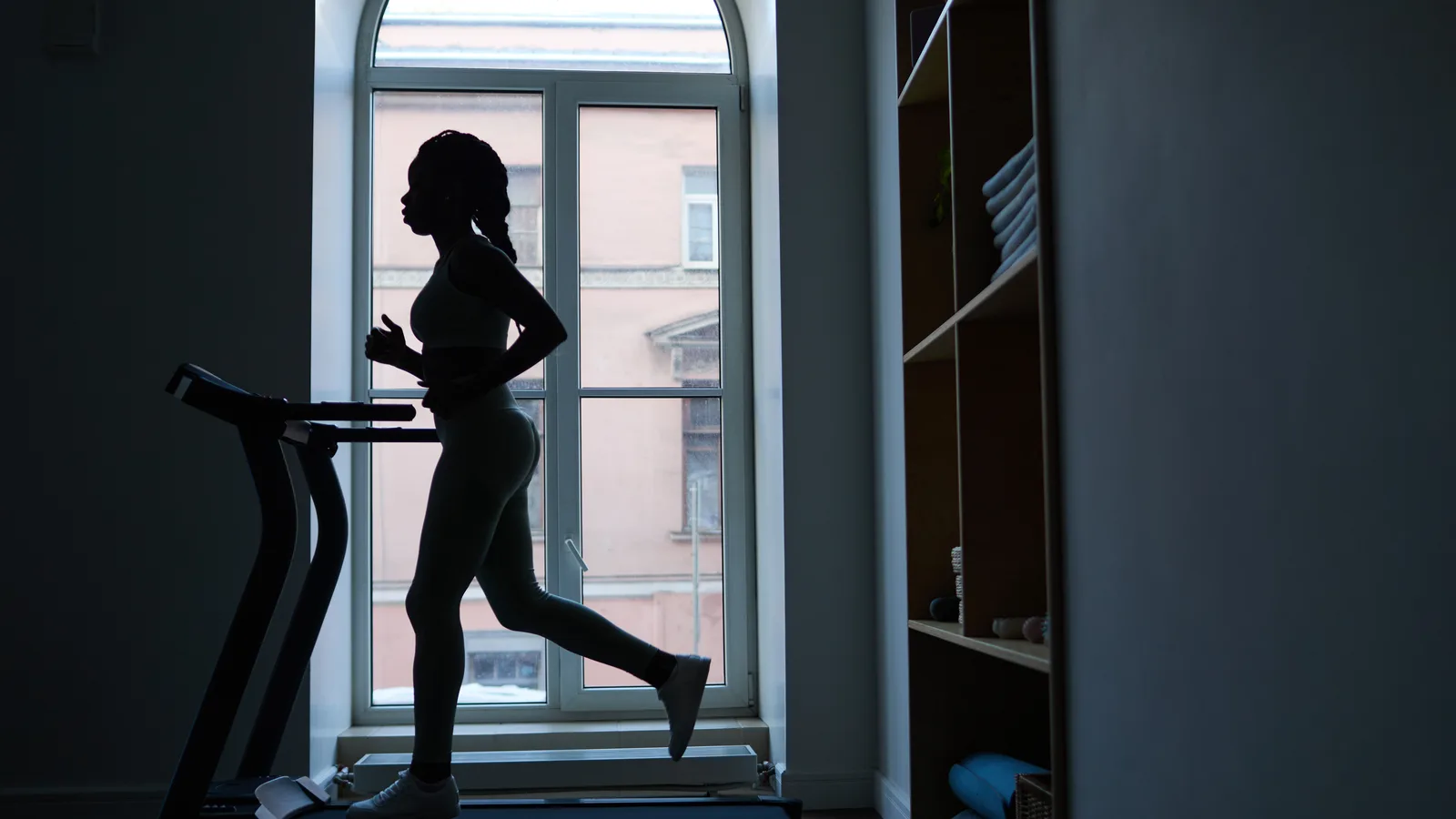
With darker evenings and colder mornings, a lot of runners move indoors this time of year, and many of them hear the same advice: set the treadmill to a 1 percent incline to make it feel like running outside. The rule is real, it comes from a specific study, and it is narrower than the way it usually gets repeated.
Why a treadmill is easier than the road
Running outdoors, you push air out of the way, and that costs energy. On a treadmill you stay in place while the belt moves under you, so there is almost no air resistance. At the same speed, that makes flat treadmill running slightly cheaper in energy than running on a level road. A slight incline adds back some of the work the missing air resistance took away.
Where the 1 percent figure comes from
The number comes from a study by Andrew Jones and Jonathan Doust of the University of Brighton, published in the Journal of Sports Sciences in August 1996. Nine trained male runners, all used to treadmill running, ran six-minute efforts at six speeds from 2.92 to 5.0 meters per second, which is about 6.5 to 11.2 miles per hour, or roughly a 9:11 mile down to a 5:22 mile. They did the full set of speeds six times: twice on a flat treadmill, once each at 1, 2 and 3 percent grades, and once outdoors on a level road. The researchers measured oxygen uptake, the standard measure of how much energy running costs.
At the two slowest speeds, about 6.5 and 7.5 miles per hour, the road was no different from the treadmill at either 0 or 1 percent. At about 8.4 miles per hour, only 1 percent matched the road. At about 9.3 and 10.2 miles per hour, the road cost more than a flat belt and matched 1 or 2 percent. At the fastest speed, the road fell between 1 and 2 percent. Across all six speeds, 1 percent was the one grade that matched outdoor running throughout, which is how the rule was born.
What the study does not cover
Nine runners, all men, all trained, running for about six minutes at a time, is a small and specific group. The study measured energy cost on a level road in still conditions; it did not account for wind, hills, downhill running or the different stride some people adopt on a moving belt. The abstract does not name a funder.
How to use it
For easy running at the slowest paces tested, roughly a 9-minute to 8-minute mile, the study found the incline made little measurable difference, so a flat belt is a reasonable stand-in for a flat road. For tempo runs and faster work, where air resistance grows, 1 percent brings the effort closer to what the same pace costs outside. If a race or workout plan is built around outdoor paces, that is where the setting earns its keep.
The rule is not a reason to crank the incline higher in the name of realism. At 2 and 3 percent, the treadmill was harder than the road at most speeds tested, which is useful as a workout but not as an imitation of a flat run.
Loading comments…