












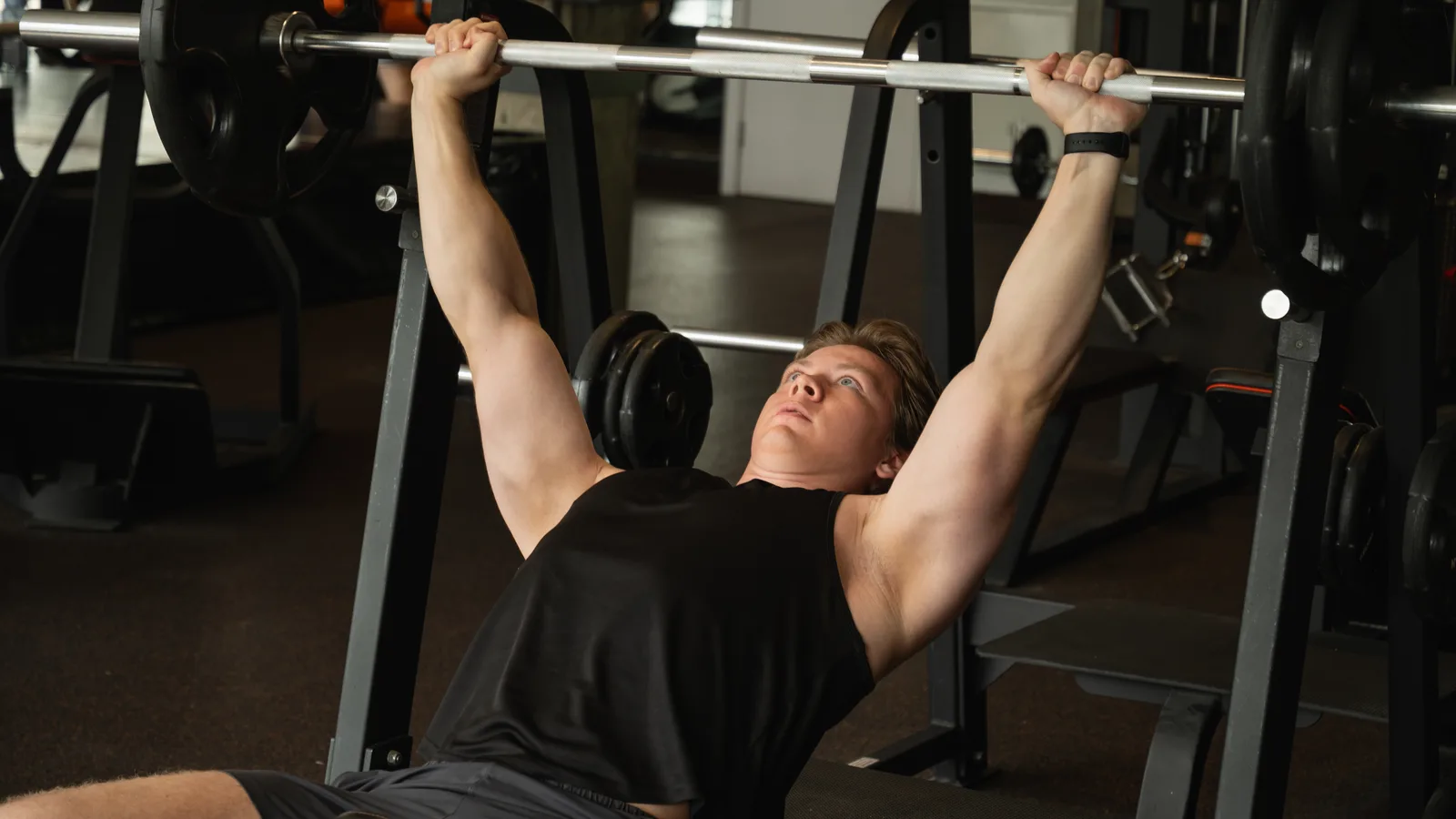
Every lifter eventually asks whether a set only counts if it ends with a rep that will not go up. A randomized trial published in Medicine and Science in Sports and Exercise, the journal of the American College of Sports Medicine, tested that question in the setting where it matters most: short workouts with a single set per exercise.
The trial
Researchers at CUNY Lehman College in the Bronx randomly assigned 42 young, resistance-trained men and women to one of two programs for eight weeks:
- Failure: every set taken to momentary muscular failure.
- Two reps in reserve (2 RIR): every set stopped when the lifter judged two more reps were possible.
Both groups did the same thing otherwise: one set each of nine exercises covering every major muscle group, twice a week. The researchers measured muscle thickness in the biceps, triceps and quadriceps, along with strength, power, muscular endurance and how accurately people could guess their reps in reserve on the bench press and squat. The paper appeared in the journal's September 2025 issue.
What they found
- Both programs worked. Most measures improved in both groups, even though many participants were coming from higher-volume programs.
- Strength and muscular endurance improved about the same whether sets went to failure or stopped two reps short.
- Muscle growth leaned slightly toward failure. Several hypertrophy measures favored the failure group, but the absolute differences were modest.
- Jump height improved more with failure training, but the statistics could not settle whether that difference was real.
- Guessing reps in reserve is a skill. Participants were more accurate on the bench press than on the squat, and they got more accurate over the eight weeks, especially on the bench.
What it does not show
This is one eight-week trial with 42 people, all young and already trained. It does not tell you what happens over a year, in beginners, in older adults or in programs with several sets per exercise, where the fatigue from repeated sets to failure adds up differently. The abstract does not list outside funding.
How to use it
The federal Physical Activity Guidelines for Americans recommend muscle-strengthening activity that works all major muscle groups on two or more days a week. This trial fits inside that: two short sessions, one hard set per exercise. Its finding suggests that for someone whose main goal is strength, ending each set with a rep or two left is enough, and that someone chasing every bit of muscle size may get a little more by finishing at failure on exercises where that is safe to do, such as machines and dumbbell isolation work, rather than heavy squats without a spotter.
Because estimating reps in reserve improves with practice, one way to learn it is to take an occasional set to failure on a safe exercise and compare where it ended with where you predicted it would.
Loading comments…