












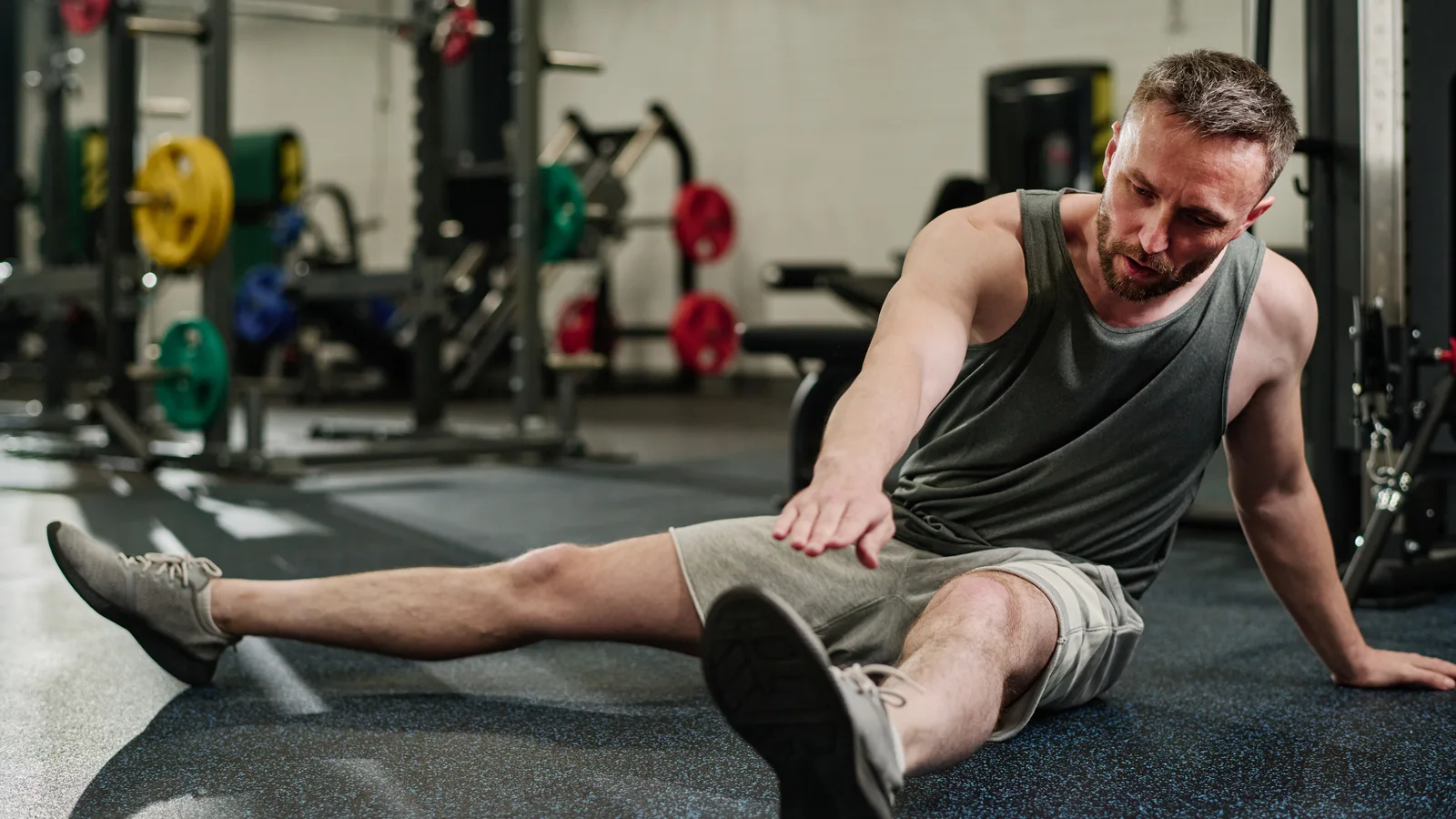
Holding a static stretch before training does reduce strength and power for a few minutes afterward, but the size of the loss depends almost entirely on how long the hold lasts. In the largest reviews, stretching a muscle for less than 60 seconds in total went with a drop of about 1 percent. Stretching it for 60 seconds or more went with a drop of roughly 4 to 7.5 percent. Dynamic warm-up movements, by contrast, showed a small gain.
Here is what each review measured, and where the numbers come from.
The 106-study review: nothing clear under 45 seconds
Anthony Kay and Anthony Blazevich published a systematic review in Medicine & Science in Sports & Exercise in January 2012. They screened 4,559 articles and kept 106 trials that tested maximal muscle performance after a single bout of static stretching.
For holds under 30 seconds, the pooled change was a 1.1 percent decrease, which the authors judged to be no detrimental effect. For holds of 30 to 45 seconds, the pooled change was a 1.9 percent decrease, also not significant. A meaningful loss became likely once a stretch reached 60 seconds or longer. The relationship between duration and loss followed an S-shaped curve and held regardless of the muscle group, the type of contraction or the performance test. The authors also noted a weakness in the field: 30 percent of the studies did not report appropriate reliability statistics.
The 104-study meta-analysis: strength took the biggest hit
A meta-analysis by Simic, Sarabon and Markovic, published in the Scandinavian Journal of Medicine & Science in Sports in 2013, pooled 104 studies published through December 2010 and split the results by what was being tested:
- Maximal strength: down 5.4 percent (95 percent confidence interval, 4.2 to 6.6 percent).
- Power: down 1.9 percent, with a confidence interval that included zero.
- Explosive performance, such as jumping and sprinting: down 2.0 percent (1.3 to 2.8 percent).
The losses did not vary with age, sex or fitness level. They were larger in isometric tests, where the muscle pushes against something that does not move, than in dynamic ones. They also grew with total stretch time, and were smallest when a stretch lasted 45 seconds or less. These averages mix short and long holds together, which is why the strength figure is higher than the short-hold numbers in the other reviews.
The 2016 review: the 60-second line, and dynamic stretching
David Behm, Blazevich, Kay and Malachy McHugh compared static, dynamic and PNF stretching (a contract-and-relax method) in a systematic review in Applied Physiology, Nutrition, and Metabolism in January 2016. A later paper by Behm and colleagues puts the number of studies in that review at 125.
Tested immediately after stretching, average performance changed by minus 3.7 percent after static stretching, minus 4.4 percent after PNF and plus 1.3 percent after dynamic stretching. Sorting the static studies by dose gave the clearest split: a 1.1 percent deficit for less than 60 seconds per muscle group, against 4.6 percent for 60 seconds or more.
The review added three qualifiers. Testing happened on average only 3 to 5 minutes after the stretch. Most studies had no further warm-up activity between the stretch and the test, and in those that did, no clear effect on performance remained. And static stretching went with a 2.2 percent benefit when the muscle was tested at long lengths. Range-of-motion gains from any type of stretching typically lasted less than 30 minutes.
What dynamic warm-ups showed
Dynamic stretching means moving a joint through its range under control, such as leg swings or walking lunges, without holding the end position. An earlier narrative review by Behm and Anis Chaouachi in the European Journal of Applied Physiology (2011) found that dynamic stretching either had no effect on later performance or improved it, especially when the dynamic work was longer. That paper described a warm-up sequence of easy aerobic activity, then large-amplitude dynamic stretching, then movements specific to the sport.
Why the older warnings were stronger
A 2019 review in Frontiers in Physiology by Helmi Chaabene, Behm and two colleagues went back over the earlier evidence. It was a narrative review without new pooled statistics, funded by the German Research Foundation and the University of Potsdam's open access fund.
The authors pointed out that some of the most cited early experiments used stretching doses nobody uses in a gym. One held calf stretches for about 30 minutes in total and recorded a 28 percent drop in maximal force. Most studies also tested static stretching alone, not inside a complete warm-up. Summing the evidence, they put the cost of short static stretching (60 seconds or less per muscle group) at 1 to 2 percent, and of longer stretching at 4.0 to 7.5 percent.
When static holds were placed inside a full warm-up, the picture shifted further. In one study the review describes, holds of 30, 60 and 120 seconds all improved range of motion, and only the 120-second holds clearly reduced strength and power. In another, holds of 5 and 30 seconds did not lower jump height. The review notes that earlier position statements, including the American College of Sports Medicine's 2011 stand, had advised against static stretching before maximal efforts, and argues that advice needs updating for short holds.
The limits
These studies measure performance within minutes, in a lab, usually in young and active adults. They do not show any effect on long-term strength gains. A loss of 1 to 2 percent is smaller than the day-to-day variation in most people's training, while the authors of the 2019 review note it could still matter in competition at the elite level.
The practical check is arithmetic: add up the seconds spent holding each muscle before a session. The reviews draw their line at 60 seconds per muscle group, and they found the remaining cost shrank or vanished when dynamic, activity-specific movement followed the stretch.
Sources
- Medicine & Science in Sports & Exercise: Effect of acute static stretch on maximal muscle performance, a systematic review (Kay and Blazevich, 2012)
- Scandinavian Journal of Medicine & Science in Sports: Does pre-exercise static stretching inhibit maximal muscular performance? A meta-analytical review (Simic and colleagues, 2013)
- Applied Physiology, Nutrition, and Metabolism: Acute effects of muscle stretching on physical performance, range of motion, and injury incidence in healthy active individuals (Behm and colleagues, 2016)
- European Journal of Applied Physiology: A review of the acute effects of static and dynamic stretching on performance (Behm and Chaouachi, 2011)
- Frontiers in Physiology: Acute Effects of Static Stretching on Muscle Strength and Power, An Attempt to Clarify Previous Caveats (Chaabene and colleagues, 2019)
Loading comments…