






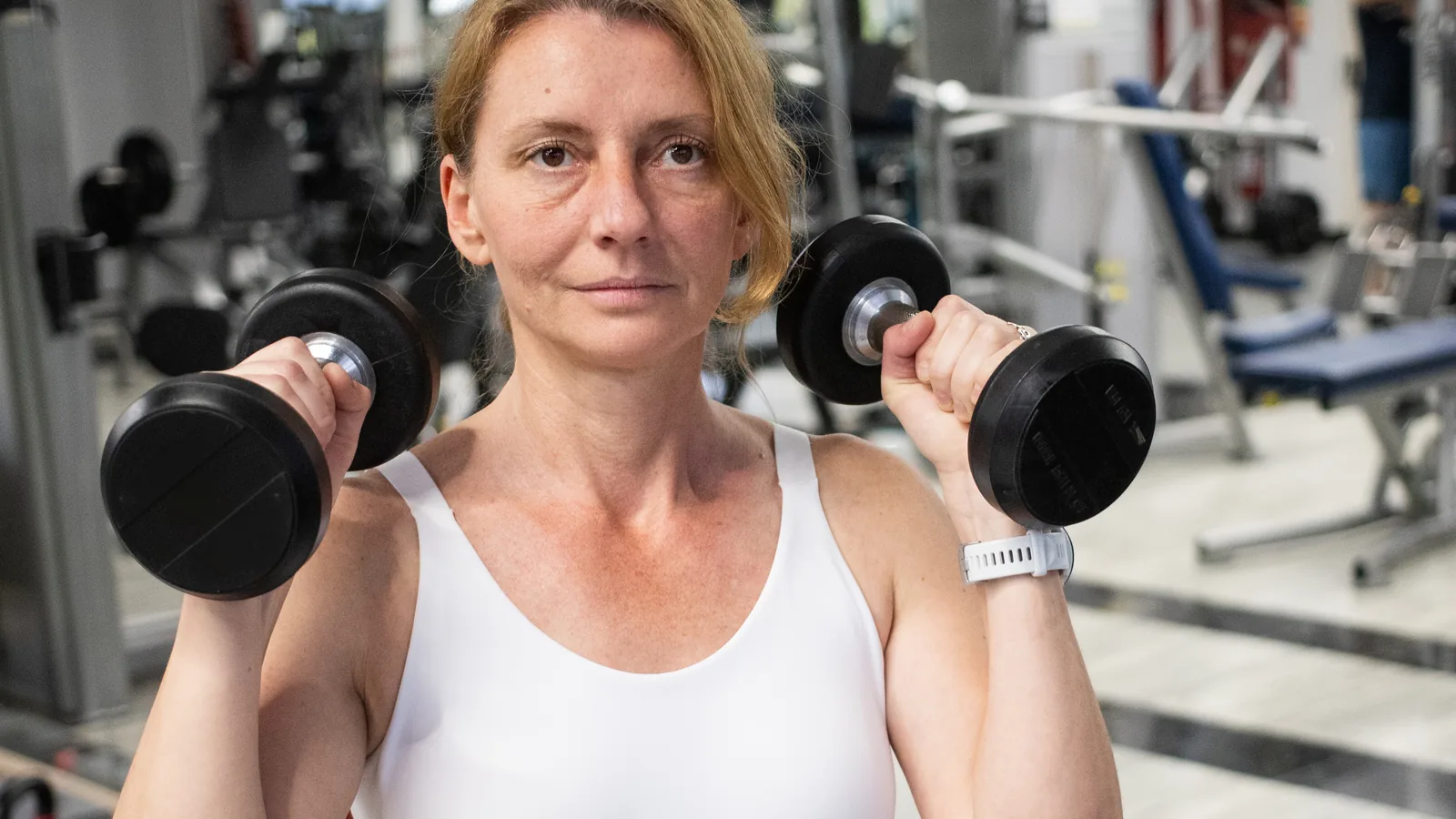
Adults who lifted weights three times a week while taking tirzepatide lost 3.57 kilograms (7.9 pounds) of lean soft tissue over 40 weeks, against 4.67 kilograms (10.3 pounds) for those on the drug alone, a difference of 1.09 kilograms (2.4 pounds). Weight loss was the same in both groups. The results come from a randomized controlled trial published in Nature Medicine on November 9, 2026, led by researchers at the University of Western Australia.
The trial
The T-REx trial was a single-center, two-arm randomized trial in Western Australia, registered with the Australian New Zealand Clinical Trials Registry in November 2023. It enrolled 120 adults aged 50 to 70 (mean 57.7), half men and half postmenopausal women, with a body mass index of 30 or higher, or 27 or higher with a weight-related condition. People with diabetes, cardiovascular disease, prior use of incretin drugs or cardiovascular medication were excluded, and participants were sedentary at the start. Both groups received weekly tirzepatide injections at the clinic, starting at 2.5 milligrams and rising by 2.5 milligrams every four weeks toward 15 milligrams by week 20, with dose reductions allowed. No diet was prescribed; participants were asked to keep protein and fiber intake steady.
The exercise group attended three supervised one-hour group sessions a week in a dedicated gym run by accredited exercise physiologists. The program ran in five eight-week phases with progressive overload, alternating upper- and lower-body days and alternating hypertrophy- and strength-focused sessions, using squats, deadlifts, leg press, lat pulldowns, chest and shoulder press and curls. Attendance averaged 91 percent. The control group had the same injection visits and assessments without the training. Fat mass and lean soft tissue mass, measured by DXA scan at baseline and every eight weeks, were the two primary outcomes.
What changed
Body weight fell 22.61 kilograms (49.8 pounds) in the tirzepatide-only group and 22.28 kilograms (49.1 pounds) in the exercise group, a difference that was not statistically significant. Fat mass fell 17.19 and 17.98 kilograms respectively, also not significantly different. The separation came in lean soft tissue: a 1.09-kilogram between-group difference with a 97.5 percent confidence interval of 0.43 to 1.75 kilograms. Appendicular lean soft tissue, the arms and legs, showed a 0.63-kilogram difference (95 percent confidence interval 0.30 to 0.96).
Strength moved in opposite directions. The drug-only group lost strength on every one-repetition maximum test: bench press down 4.09 kilograms (8.4 percent), lat pulldown down 4.42 kilograms (6.5 percent), knee extension down 4.42 kilograms (9.0 percent). The exercise group gained on all three: bench press up 4.68 kilograms (10.7 percent), lat pulldown up 8.58 kilograms (15.7 percent), knee extension up 5.88 kilograms (17.5 percent). Knee extension strength relative to body weight, which the authors treat as a marker of how easily a person moves, was stable in the drug-only group and markedly improved with training. Blood pressure, glucose, insulin, HbA1c, total cholesterol and triglycerides improved similarly in both groups; exercise added nothing measurable there.
Side effects and dropouts
About half of all participants reported nausea. Lightheadedness was reported by 31 percent of the drug-only group and 24 percent of the exercise group; fainting by 5 and 2 percent; low blood pressure by 10 and 15 percent. Six serious adverse events occurred, five in the drug-only arm and one in the exercise arm, all judged unrelated to the study treatments. 111 of 120 participants (93 percent) finished.
Funding and limits
Eli Lilly supplied the tirzepatide through an investigator-initiated trial program, reviewed the protocol and a draft manuscript without changes to content, and, per the paper, had no other role. Two authors held Australian Postgraduate Awards and the senior author reports a Western Australian state research award. Several authors report speaker honoraria or advisory roles with Eli Lilly, Novo Nordisk or Boehringer Ingelheim.
The authors name their limits. DXA measures lean soft tissue, not muscle alone, and MRI or CT were judged too costly or time-consuming. There was no placebo arm without the drug. The trial was open-label and strength testers knew who had trained. The sample was middle-aged to older, initially sedentary and free of diabetes and heart disease, so the result may not transfer to other groups. Protein intake was encouraged but not controlled, and food diaries were collected only in a subset. Whether a 1-kilogram difference in lean tissue changes long-term outcomes, and whether three supervised sessions a week is feasible in routine care, are both open questions the paper raises rather than answers.
One trial of 120 people at one center does not settle how much lean mass matters during drug-assisted weight loss, but it does give randomized numbers on what structured lifting adds: no extra weight loss, about a kilogram of preserved lean tissue, and a reversal of strength loss. For a reader taking or considering tirzepatide, the question for the prescribing clinician is how resistance training fits alongside it, and what protein intake the clinician wants maintained during treatment.
This article reports research and expert guidance. It is not medical advice. Talk to your clinician before changing medication, treatment or a medical diet.
Loading comments…