












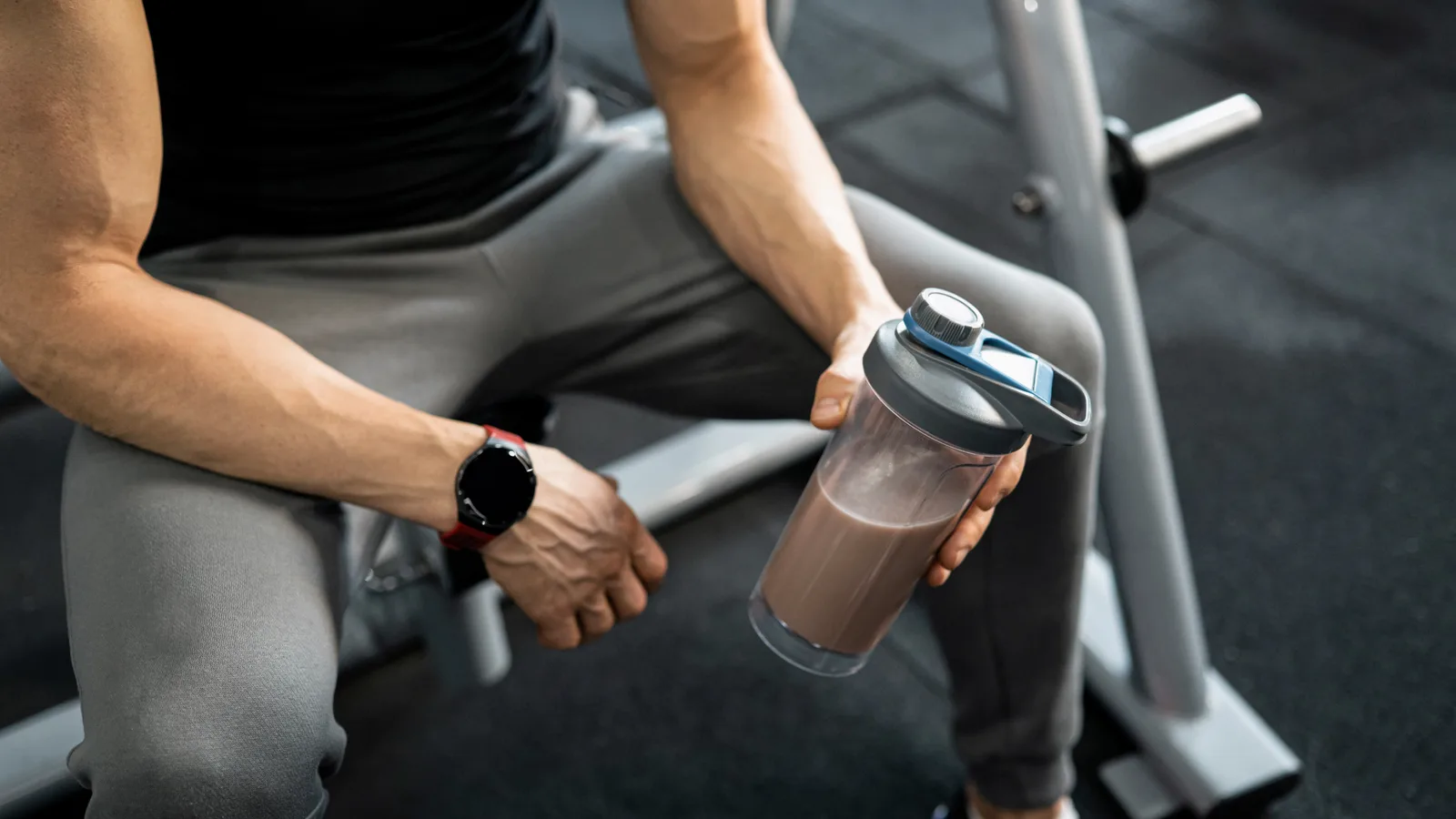
The rule is repeated in every weight room: drink the shake within 30 minutes of the last set or the workout is wasted. The idea has a name, the anabolic window, and it has been tested. When researchers pooled the trials, the timing of protein around a workout stopped mattering once they accounted for how much protein people ate across the whole day.
Where the idea came from
Resistance exercise and protein each raise the rate at which muscle builds new protein, and the two together do more than either alone. That part is not in dispute; the International Society of Sports Nutrition says so in its position stand on protein and exercise. The window theory went a step further and claimed the effect depends on getting protein in during a short period right after training.
What 23 trials found
In 2013 three researchers pooled the randomized trials that had tested protein timing for at least several weeks of training and published the result in the Journal of the International Society of Sports Nutrition. The muscle-size analysis covered 23 studies and 525 people. The strength analysis covered 20 studies and 478 people.
A first, simple pooling showed a small to moderate advantage for muscle size in the groups that took protein close to training, and none for strength. Then the authors looked at why. In many of the trials, the timed-protein group was also simply eating more protein in total than the comparison group. Once the analysis controlled for that and other differences between studies, there was no significant effect of timing on muscle size or on strength. Total protein intake was the strongest predictor of muscle gain.
Before or after: a direct test
A 2017 trial in the journal PeerJ tested the window head on. Twenty-one men with more than a year of lifting experience were randomized to take 25 grams of protein either immediately before or immediately after each session of a total-body program (three sets of 8 to 12 repetitions per exercise) for 10 weeks. Muscle size, strength and body composition changed about the same in both groups. The authors' reading was that the useful interval for protein may be several hours wide, depending on when the last meal before training was eaten.
It was a small trial in trained young men, and one of its authors worked for a nutrition information company, as the paper discloses. It cannot say much about older adults or about people who train after a long fast.
What the sports nutrition society says to aim for
The society's 2017 position stand puts the numbers in this order of importance:
- The day's total comes first. For most people who exercise, 1.4 to 2.0 grams of protein per kilogram of body weight a day is enough to build or maintain muscle. For a 154-pound (70-kilogram) person that is about 98 to 140 grams.
- Then the size of each serving. About 0.25 grams per kilogram, or 20 to 40 grams, of a high-quality protein at a time. For the same person, 0.25 grams per kilogram is roughly 18 grams.
- Then the spacing. Servings spread fairly evenly through the day, about every three to four hours.
- Timing around the workout comes last. The stand says benefits come from protein eaten before or after training, and calls the best time a matter of individual tolerance. The muscle-building effect of a session lasts at least 24 hours, it says, though it likely fades as the hours pass.
Several of the stand's authors list affiliations with supplement companies, which the paper discloses, and the stand notes that whole foods can meet these targets.
When the clock matters more
The trials leave a few cases where sooner is the safer reading of the evidence:
- Training fasted. If the last meal was many hours before the session, as with a workout before breakfast, there is no earlier protein still being digested. The 2017 trial's authors tie the width of the window to the pre-workout meal for that reason.
- Long gaps. If the next meal would be four or five hours after training, a serving sooner keeps the day on the three-to-four-hour spacing the position stand describes.
- Falling short on the total. If the post-workout serving is the one that gets the day to its target, it matters because of the total, not the minute.
How to check your own day
Write down one ordinary day's protein from food labels or the U.S. Department of Agriculture's FoodData Central database. Compare the total with the range for your weight, then look at how it is spread. For many people the gap is at breakfast, not in the half hour after the gym. Anyone with kidney disease has different protein limits and should set a target with a clinician.
This article reports research and expert guidance. It is not medical advice. Talk to your clinician before changing medication, treatment or a medical diet.
Sources
- Journal of the International Society of Sports Nutrition: The Effect of Protein Timing on Muscle Strength and Hypertrophy: A Meta-Analysis (2013)
- PeerJ: Pre- Versus Post-Exercise Protein Intake Has Similar Effects on Muscular Adaptations (2017)
- Journal of the International Society of Sports Nutrition: International Society of Sports Nutrition Position Stand: Protein and Exercise (2017)
- U.S. Department of Agriculture: FoodData Central
Loading comments…