












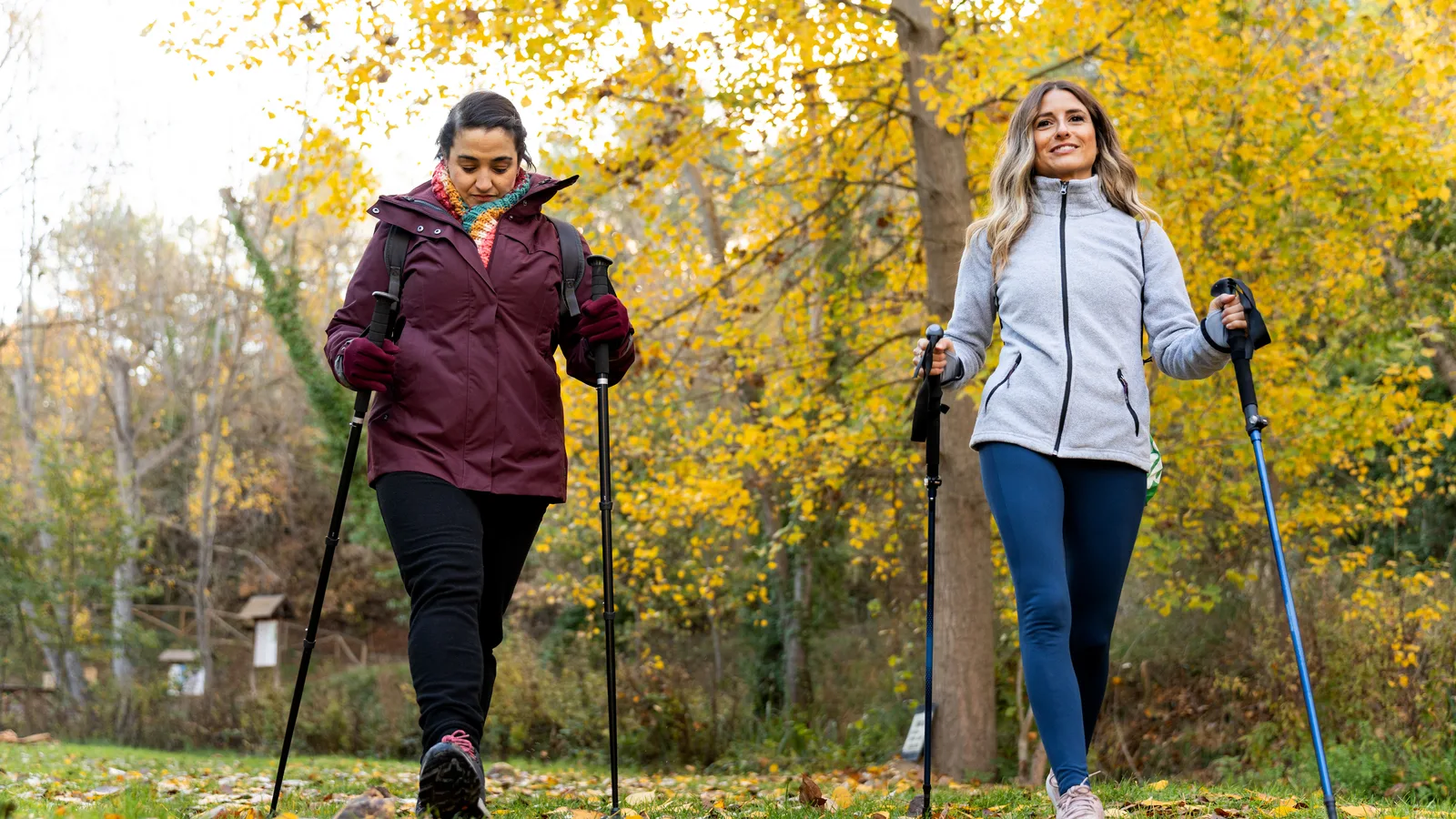
Nordic walking is walking with two poles planted behind the body and pushed with each stride, so the arms and upper back work along with the legs. It started as summer training for cross-country skiers and is now sold in sporting goods stores as a way to walk harder without running. The most cited summary of what it does is a systematic review in the American Journal of Preventive Medicine, published in January 2013 by researchers at Paracelsus Medical University in Salzburg, Austria.
What the review included
The authors searched the research from November 2010 to May 2012 and found 16 randomized controlled trials with a total of 1,062 participants, plus 11 observational studies with 831 participants. Many of the people studied had a condition such as heart disease, diabetes, obesity, peripheral artery disease or chronic pain, and the trials compared Nordic walking with brisk walking without poles, with jogging, or with no exercise.
What it found
Across the studies, Nordic walking improved resting heart rate, blood pressure, exercise capacity, maximal oxygen consumption and quality of life. On short- and long-term measures of heart rate, oxygen use and quality of life, the authors judged it better than brisk walking without poles, and on some measures better than jogging. The likely reason is simple: pushing the poles brings the arms, shoulders and trunk into the work, so the same walking speed costs more energy.
What it does not show
This was a systematic review, not a meta-analysis, so it did not pool the trials into a single effect size, and the studies varied widely in who took part, how long they ran and how they were measured. Many were small. Because so many participants had a chronic condition, the results describe Nordic walking as exercise for patients at least as much as for healthy walkers. The review is also more than a decade old; newer trials have been published since.
Technique matters
The extra effort depends on actually pushing the poles. Carrying them, or planting them in front like a hiking pole for balance, turns Nordic walking back into ordinary walking with poles in hand. Instructors teach a diagonal pattern: the left pole lands as the right foot lands, the pole tip angles backward, and the hand pushes past the hip. Poles are usually sized so the elbow sits near a right angle when the pole tip is on the ground.
Where it fits
The Physical Activity Guidelines for Americans count brisk walking as moderate-intensity aerobic activity and recommend 150 to 300 minutes a week. Nordic walking fits under the same heading, and for someone whose knees or hips limit running, it is one way to raise the effort of a walk. People who walk with poles for balance after an injury or surgery should check with their care team before changing how they use them.
This article reports research and expert guidance. It is not medical advice. Talk to your clinician before changing medication, treatment or a medical diet.
Loading comments…