












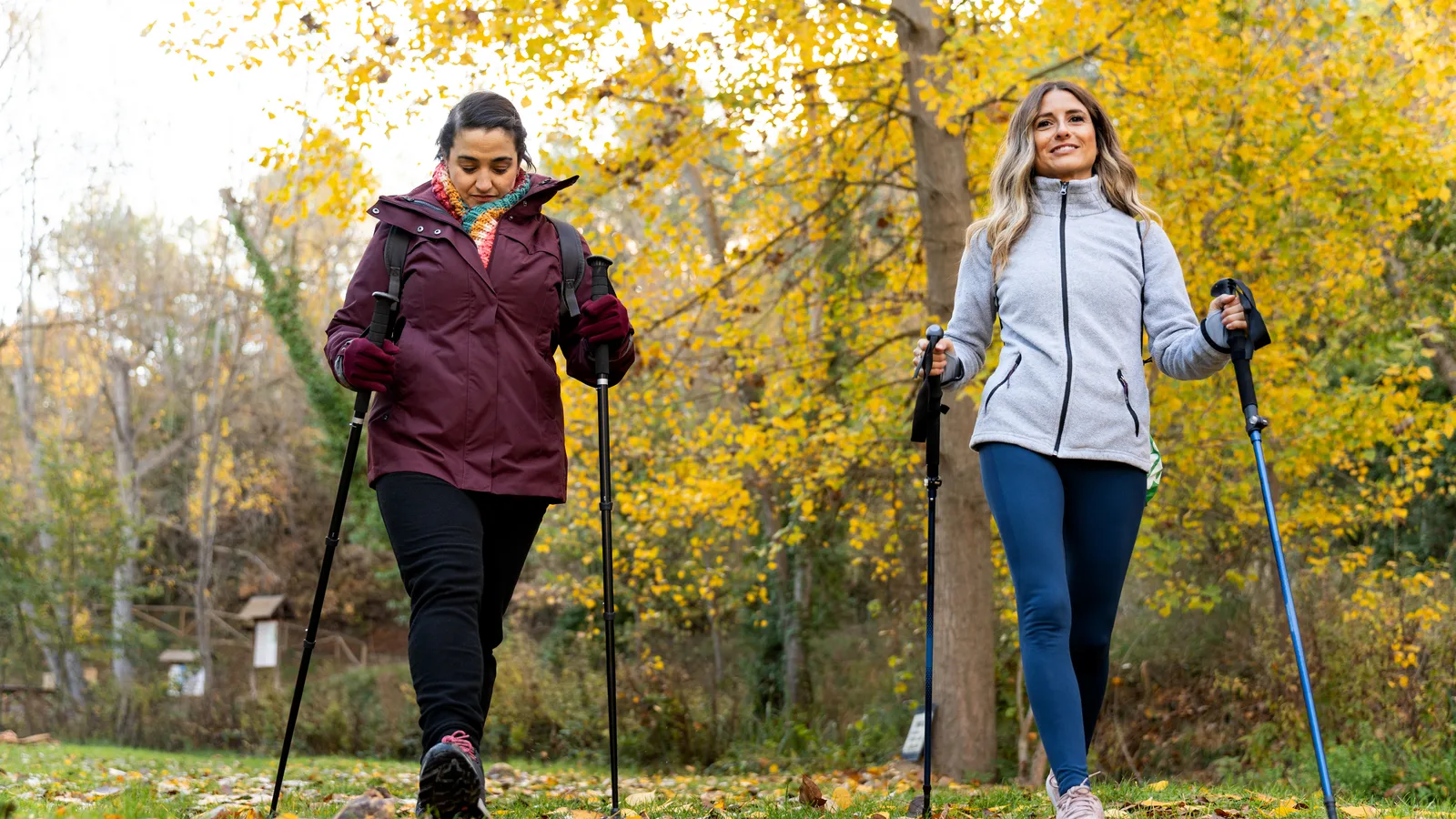
Walking with a pair of poles turns an ordinary walk into one that works the arms and shoulders too, and it has a randomized trial behind it. Researchers at the University of Ottawa Heart Institute assigned 130 people with coronary artery disease to 12 weeks of Nordic walking, high-intensity interval training or moderate-to-vigorous continuous training. Six months after the start, the Nordic walkers had added the most distance on a standard walking test.
What the trial measured
The study, published in the Canadian Journal of Cardiology in August 2022, ran each program for 12 weeks and then followed participants for another 14 weeks without supervision. The main measure was the six-minute walk test, which records how far a person covers in six minutes and is a common gauge of everyday functional capacity in heart patients. The team also tracked quality of life with two questionnaires and depression symptoms with the Beck Depression Inventory.
Of the 130 randomized, 86 completed the week-26 assessment: 29 in the interval group, 27 in the continuous group and 30 in the Nordic walking group.
The results
- All three programs helped. Walk distance, quality of life and depression symptoms all improved from the start to week 26.
- Nordic walking added the most distance. Six-minute walk distance rose by an average of 94.2 meters (about 309 feet) in the Nordic walking group, against 59.9 meters for interval training and 55.6 meters for continuous training. Both differences were statistically significant.
- The gains held. Between week 12 and week 26, when nobody was supervising, walk distance and physical quality of life kept improving.
What it does not show
The trial measured how far people could walk, not the heart's pumping function, and it did not track heart attacks or deaths. A third of the randomized participants were not assessed at week 26, which weakens the comparison, and everyone was a patient in a cardiac rehabilitation setting at one Canadian institute. The abstract does not name a funder. The authors suggest the poles may help with walking speed, posture and stride, but the trial was not designed to prove why.
Where it fits for everyone else
For healthy adults, the Physical Activity Guidelines for Americans count brisk walking, at 2.5 miles per hour or faster, as moderate-intensity activity, and hiking uphill or with a heavy pack as vigorous. The target is 150 to 300 minutes of moderate activity a week, or 75 to 150 of vigorous, or a mix. The guidelines single out walking for older adults as an activity with many health benefits and a low risk of injury that can be done year round. Poles bring the arms into that walk.
For people with coronary artery disease, this trial ran inside a supervised rehabilitation program, and the safe starting point for any program after a heart diagnosis is the one set with the cardiac team.
This article reports research and expert guidance. It is not medical advice. Talk to your clinician before changing medication, treatment or a medical diet.
Loading comments…