












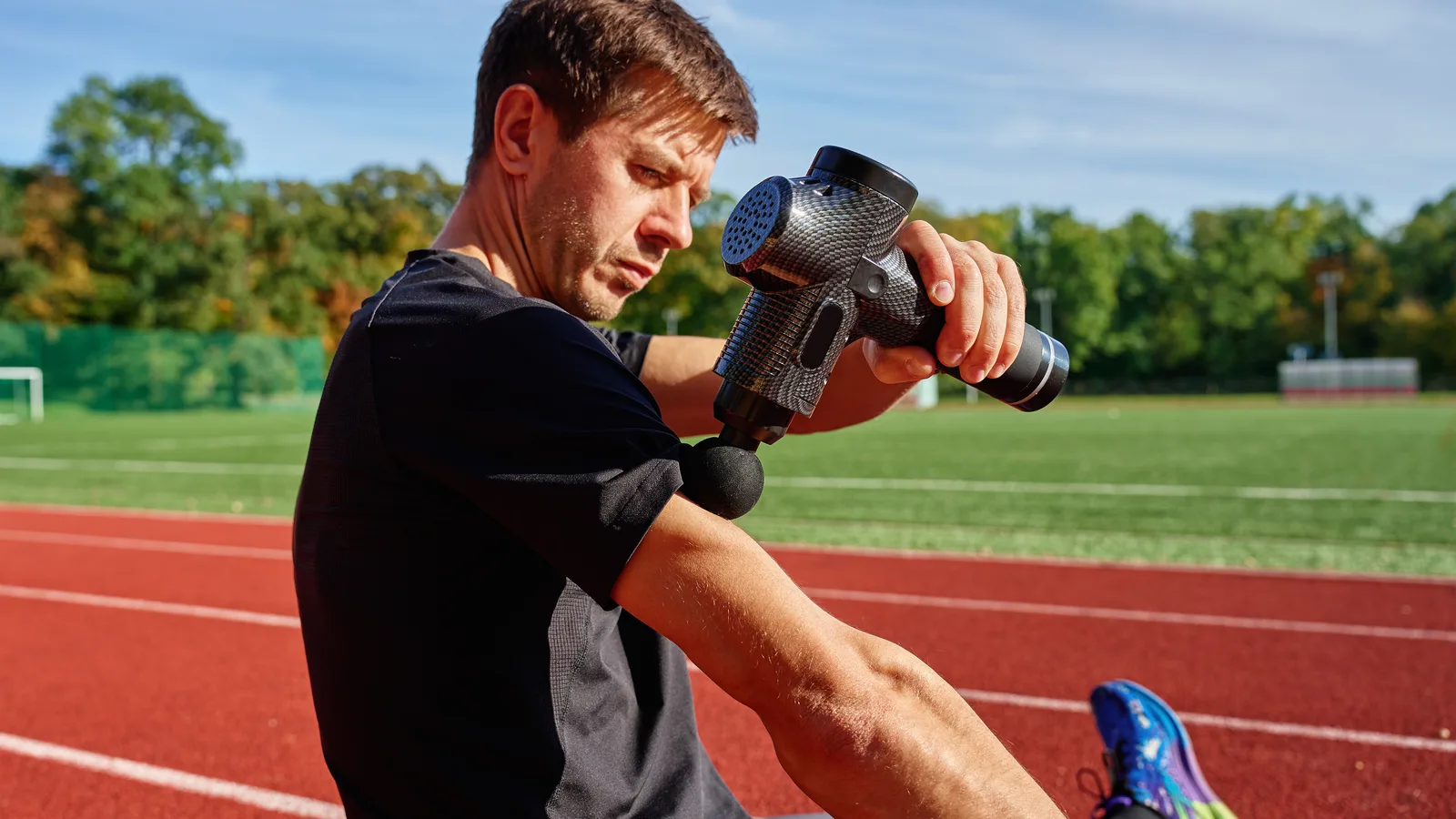
A massage gun is now standard kit in a lot of runners' bags, sitting next to the ice pack that came first. A randomized trial published November 10 in Scientific Reports compared the two head to head, together and against simply resting, over the three days after a hard bout of calf work.
How the trial worked
Researchers from the Medical University of Silesia and colleagues in Poland and Montenegro recruited 80 recreational runners aged 18 to 40. Each did an eccentric calf exercise protocol, the slow lowering movement that reliably causes next-day soreness, and was then randomly assigned to one of four groups of 20:
- Ice massage
- Percussive massage with a massage gun
- Ice massage and percussive massage combined
- Passive recovery, meaning rest
The three active treatments started right after the exercise and were repeated twice a day, seven sessions in all over 72 hours. All 80 runners finished. The trial was registered in advance, the authors report no funding and no competing interests, and it was single center.
What changed
All three active treatments came out ahead of rest on every measure that lasted to 72 hours:
- Soreness fell 1.20 to 1.35 points more from just after the exercise to 72 hours than it did with rest.
- Stiffness, measured by ultrasound in two calf muscles and the Achilles tendon, dropped further with every active treatment than with rest, with the largest differences at the Achilles.
- Reactive strength, a hopping test of how quickly the calf and tendon rebound, improved most with the combination: 0.24 meters per second more than rest. Ice alone added 0.14 and the massage gun alone 0.11.
A blood marker of muscle damage, lactate dehydrogenase, showed early differences that were gone by 72 hours.
The authors compared the combination with each single treatment as an exploratory analysis. It led on reactive strength by 0.10 meters per second over ice and 0.13 over the massage gun. They say plainly that this edge needs confirming.
What it does not show
The trial studied one muscle group after one lab protocol, in recreational runners under 40, over three days. It did not test whether any treatment changed race times or training over weeks, and it compared active care with doing nothing rather than with an easy run or other common habits. Twice-daily sessions for three days is also more treatment than most runners give a sore calf. The published version is an accepted manuscript that may still be edited.
Where it fits
Recovery research on cold has been mixed, with whole-body cold water immersion in particular raising questions about blunting training gains. This trial used local ice massage on one muscle, a smaller dose, and found it helped short-term soreness and stiffness. It adds a randomized comparison to a gadget category that has had more marketing than trials.
Using it
The practical reading is narrow: in this trial, doing something local and repeated for a sore calf beat doing nothing over three days, and pairing ice with a massage gun gave the best rebound. Pain that is sharp, one-sided or not easing after a few days is a reason to see a clinician rather than reach for either tool.
This article reports research and expert guidance. It is not medical advice. Talk to your clinician before changing medication, treatment or a medical diet.
Loading comments…