












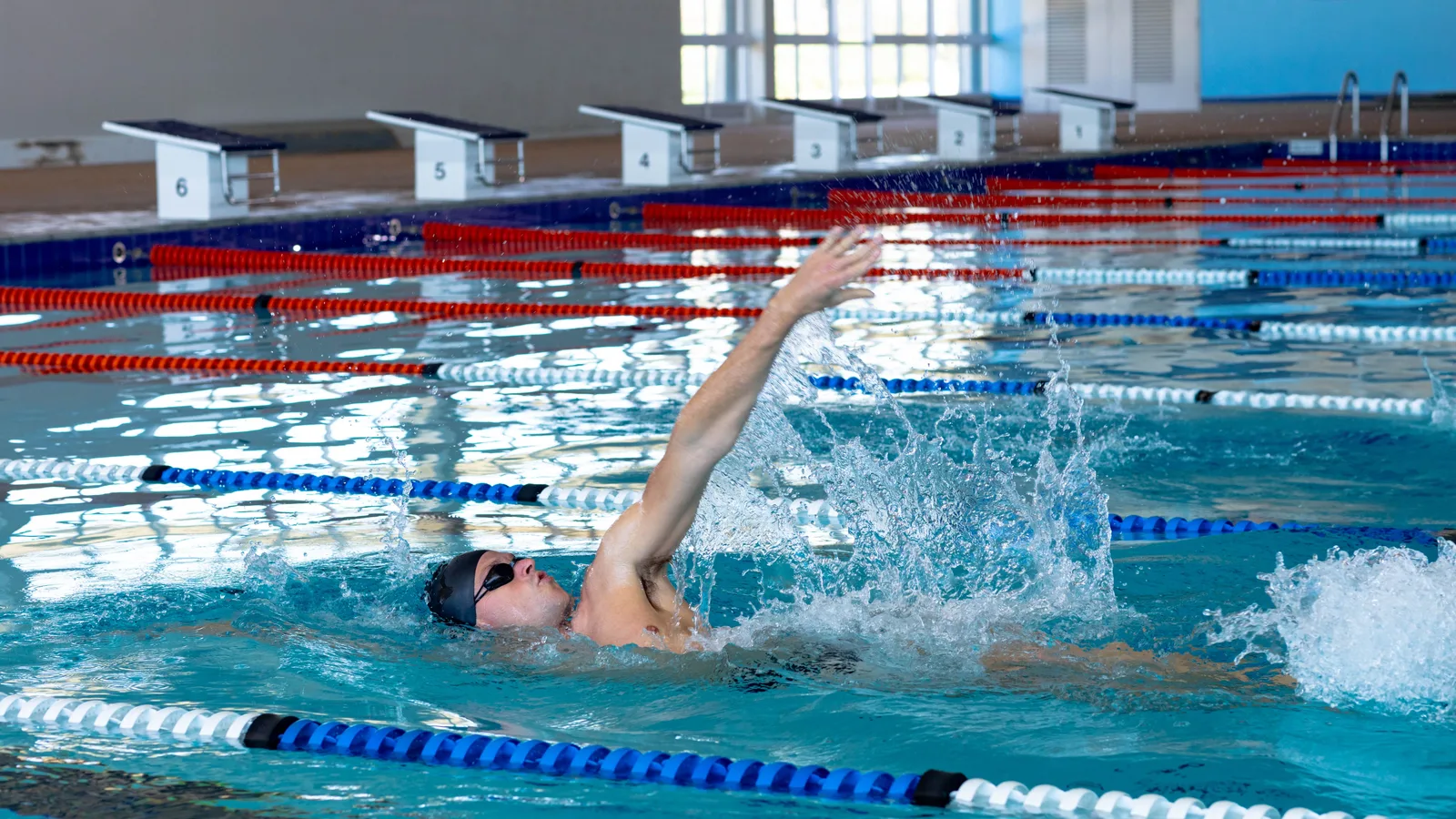
Swimmers have about the same bone mineral density as people who do no sport at all, and clearly less than athletes in sports that involve running and jumping. That is the consistent finding across four systematic reviews published between 2013 and 2024. The reviews found no sign that swimming harms the spine or hip. They also found little sign that it builds them.
Why the question comes up
Bone responds to load. Impact with the ground and the pull of muscle against bone both signal the skeleton to add or keep mineral. Water supports most of a swimmer's body weight, so hours in the pool deliver muscle pull without impact. Researchers have asked for decades whether that leaves swimmers with weaker bones than their fitness would suggest.
What 64 studies showed
The broadest look is a systematic review in PLoS One, published August 7, 2013, by Alejandro Gomez-Bruton and colleagues at the University of Zaragoza in Spain. It gathered 64 studies of swimmers' bone mass, structure and metabolism. Most found similar bone mineral density in swimmers and inactive comparison groups, and lower values in swimmers than in athletes from high-impact sports. The authors concluded that swimming does not appear to damage bone but is not among the more effective sports for raising bone mass.
The review also reported that swimmers showed higher bone turnover than inactive people, which the authors suggested could produce a stronger structure than density alone shows. The authors named limits: the studies were too varied to pool into one statistical estimate, only English and Spanish papers were included, and most studies did not record the dryland training swimmers did. The work was supported by Spain's Ministry of Economy and Competitiveness.
Children, teens and young adults
The same group followed with two meta-analyses, each pooling 14 studies. The first, in Sports Medicine in March 2016, covered children and adolescents. Young swimmers had bone density similar to inactive peers and lower than peers in high-impact sports, and the gaps at the hip and lower spine tended to widen with age. The authors wrote that swimmers might need added bone-loading exercise.
The second, in the Journal of Sports Sciences in February 2018, covered adults of 18 to 30, the years when bone mass peaks. Whole-body bone density in swimmers did not differ meaningfully from that of non-athletes. Against high-impact athletes the differences were large: standardized gaps of 1.21 for the whole body, 1.51 at the femoral neck (the narrow part of the hip) and 0.84 at the lower spine, all favoring the impact athletes.
The 2024 update, and the shin
A systematic review and meta-analysis in Sports Medicine, published in September 2024 by a University of Porto team, drew on 36 human reports and 16 rodent studies. In people, bone density at the lower spine, hip and femoral neck was similar in swimmers and non-athletic controls. One site differed. At the shaft of the tibia, swimmers had a larger cross-section but a thinner outer layer of bone, and the rodent studies pointed the same direction. The authors concluded that swimming may negatively affect that part of the shin bone and found no evidence of a negative effect elsewhere.
What about older swimmers
The 2013 review noted several studies in which swimmers over 40 had higher arm bone density than inactive people, and one year-long study in which postmenopausal former swimmers lost less bone than controls. The reviewers were cautious about both. Those studies generally did not account for other activity, calcium intake or muscle mass, and the former swimmers were about three times as active as the comparison group, so swimming itself could not be credited.
Nearly all of this evidence compares groups at one point in time. That design shows an association. It cannot rule out that people with a certain build choose swimming, or that swimmers' other habits explain the result.
What the federal guidelines add
Federal physical activity guidance treats bone loading as its own category for young people. The Centers for Disease Control and Prevention says those aged 6 to 17 need bone-strengthening activity, such as jumping and running, on at least 3 days a week, within their 60 minutes of daily activity. For adults, the Physical Activity Guidelines for Americans call for muscle-strengthening activity, such as lifting weights or push-ups, on at least 2 days a week alongside aerobic activity.
For a lap swimmer, the practical question is what else in the week loads the skeleton. Anyone with osteoporosis, a past fracture or a family history of either can ask a clinician whether a bone density scan is due and which loading activities fit their situation.
This article reports research and expert guidance. It is not medical advice. Talk to your clinician before changing medication, treatment or a medical diet.
Sources
- PLoS One: Is bone tissue really affected by swimming? A systematic review (2013)
- Sports Medicine: The effect of swimming during childhood and adolescence on bone mineral density, a systematic review and meta-analysis (2016)
- Journal of Sports Sciences: Swimming and peak bone mineral density, a systematic review and meta-analysis (2018)
- Sports Medicine: Does swimming exercise impair bone health? A systematic review and meta-analysis (2024)
- CDC: Child activity, an overview of the physical activity guidelines for ages 6 to 17
- HHS: Top 10 things to know about the Physical Activity Guidelines for Americans
Loading comments…