












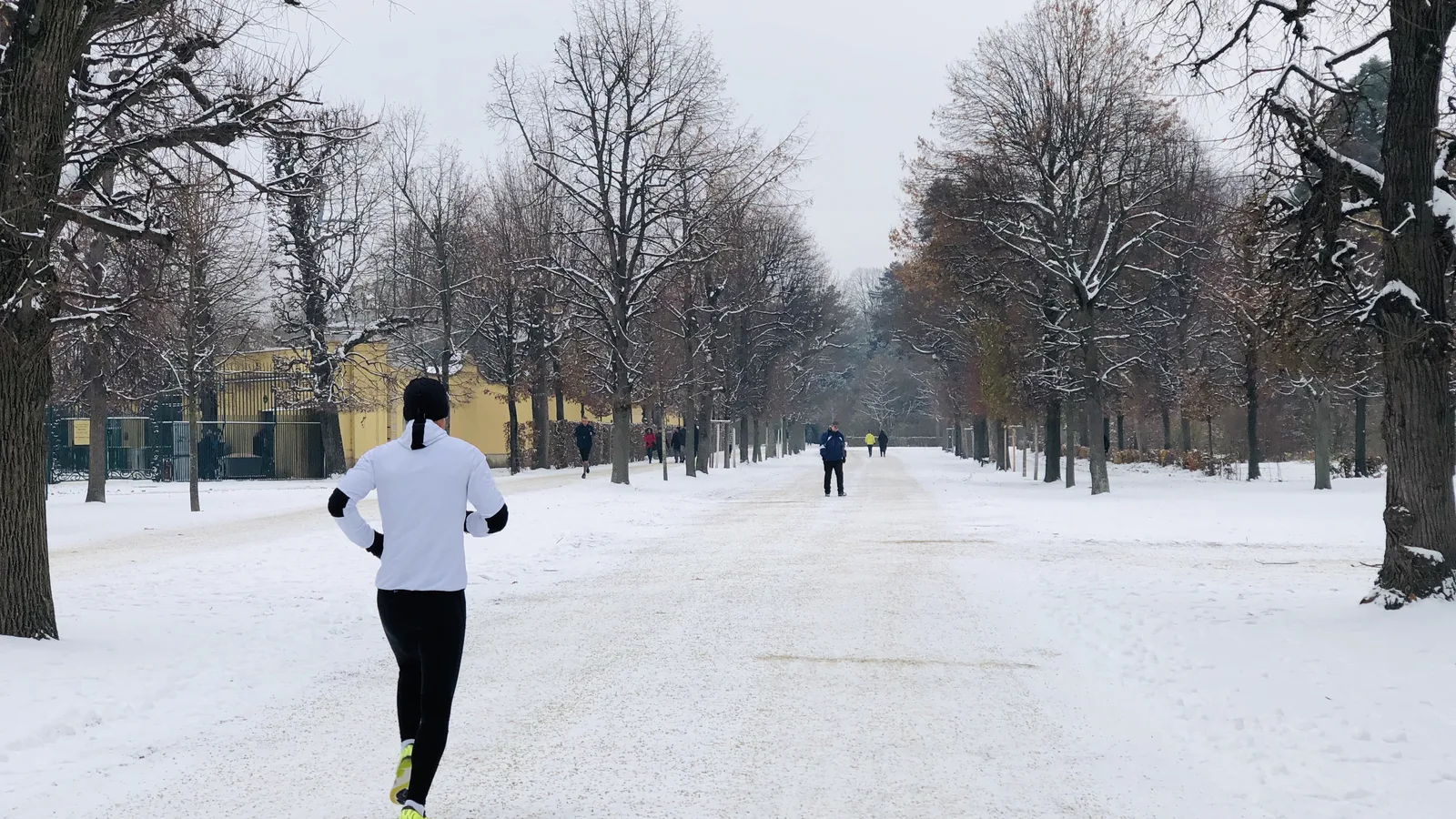
The first runs below freezing each November raise the same question: how much to wear. Too little and fingers and ears go numb in the first mile. Too much and you are soaked with sweat by mile three, and wet clothing loses heat fast once you slow down. The answer starts with a number the forecast already gives you.
Start with wind chill, not the temperature
The National Weather Service's wind chill index estimates how cold exposed skin feels when wind strips heat away from it. It applies at 50 degrees Fahrenheit and below, with wind above 3 mph, and it is calculated from the air temperature and the wind speed. Using the Weather Service formula:
- 20 degrees with a 5 mph wind feels like about 13 degrees.
- 20 degrees with a 15 mph wind feels like about 6 degrees.
- 10 degrees with a 10 mph wind feels like about 4 below zero.
- 0 degrees with a 15 mph wind feels like about 19 below, the point at which the Weather Service says exposed skin can freeze in 30 minutes.
Running adds its own wind. Running into a headwind adds your own speed to the wind across your face, so the stretch into the wind is the coldest part of a winter run, and finishing with the wind at your back means the coldest air meets you before you are sweaty.
How to layer
The Centers for Disease Control and Prevention's cold stress guidance, written for people who work outside, sets out principles that carry straight over to running:
- Several thin layers beat one thick one. Layers trap warm air, and you can take one off and tie it around your waist.
- Protect the ends: ears, face, hands and feet. These lose heat and freeze first.
- Wear a hat. It reduces heat lost from the head.
- Keep spares. Extra socks, gloves and a hat in the car or bag for after the run.
In running terms, that usually means a moisture-wicking base layer next to the skin (synthetic or wool rather than cotton, which holds sweat), an insulating middle layer on the coldest days, and a light wind-resistant shell on top. A buff or neck gaiter that pulls over the nose and mouth covers the face, one of the places the CDC singles out. Because the body warms up once it is moving, dressing so the first few minutes feel cool avoids the sweat-soaked layers that chill you later.
Signs to stop and get warm
The CDC lists the warning signs of frostbite as redness or pain in a patch of skin, often the first sign, then skin that turns white or grayish-yellow, feels unusually firm or waxy, or goes numb. For hypothermia in adults it lists shivering, exhaustion, confusion, fumbling hands, memory loss, slurred speech and drowsiness. Wet clothing and a long, slow finish raise the risk, which is why a cold run is better planned as loops near home than a long point-to-point.
The CDC advice for either is to get medical attention as soon as possible, move to a warm room, remove wet clothing and warm up under dry layers. Frostbitten skin goes in water that is warm to the touch, and is never rubbed, massaged or warmed with a heating pad, stove or fireplace. A body temperature below 95 degrees needs medical help right away.
This article reports research and expert guidance. It is not medical advice. Talk to your clinician before changing medication, treatment or a medical diet.
Loading comments…