






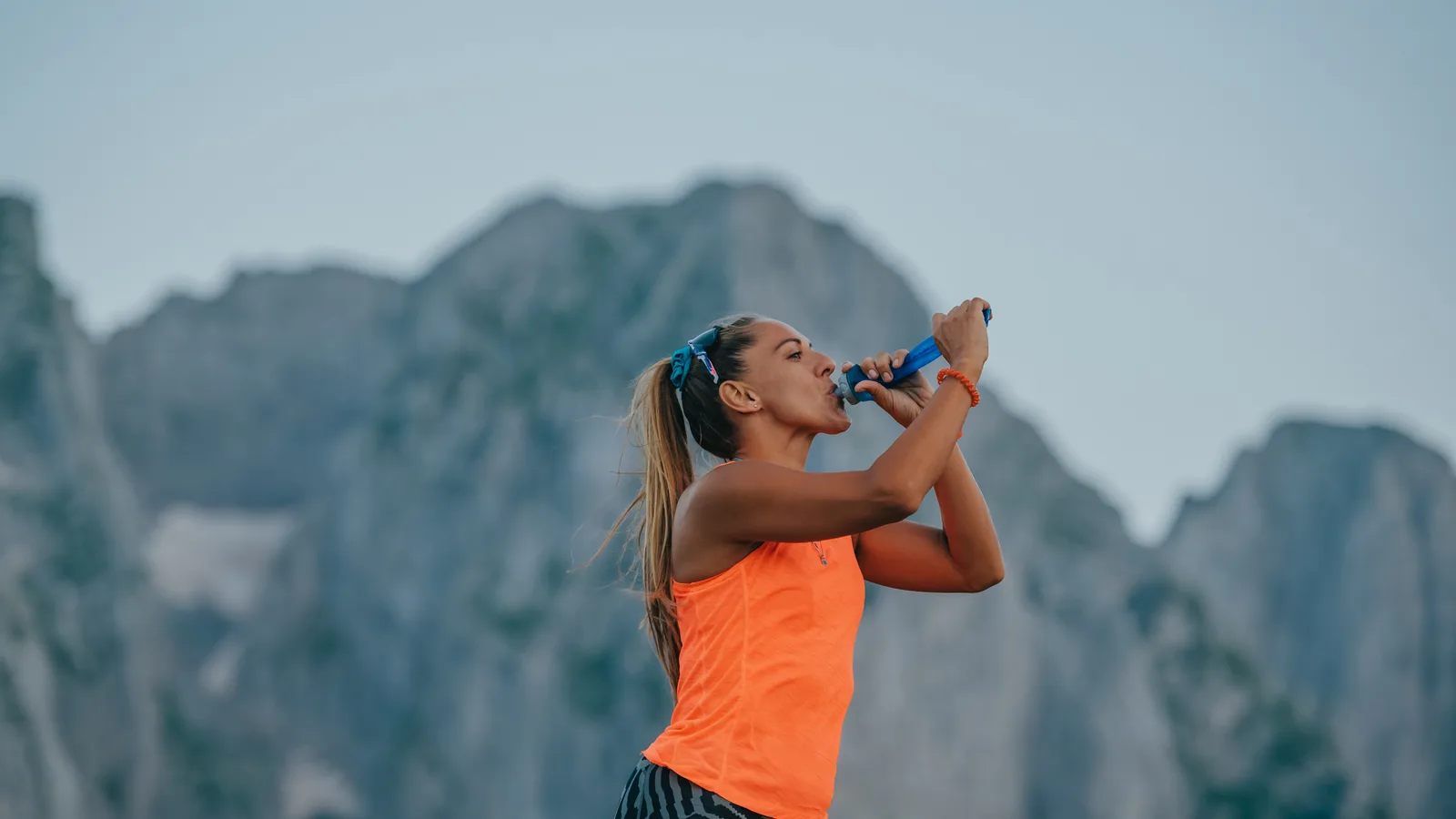
The National Academies of Sciences, Engineering, and Medicine put adequate total water intake for adults at about 2.7 liters a day for women and 3.7 liters for men. Total is the key word: the figure counts every source of water, and roughly a fifth of it typically comes from food. The eight-glasses rule never came from that report, and the report's numbers are both higher and more flexible than it.
Where the numbers come from
The figures are Adequate Intakes from the National Academies' Dietary Reference Intakes for water and electrolytes, the same series federal nutrition policy draws on. An Adequate Intake is set when there is not enough evidence for a precise requirement, so the panel used the median water intake of healthy Americans in national survey data. In plain terms, it describes what well-hydrated people already take in rather than a minimum anyone must hit.
The panel estimated that about 80 percent of total water comes from drinks and about 20 percent from food. That puts beverages at roughly 3.0 liters, about 13 cups, for men and 2.2 liters, about 9 cups, for women. Coffee, tea, milk and soup all count toward it. Fruits and vegetables such as watermelon, cucumber, lettuce and oranges are mostly water and carry a meaningful share.
Why there is no single number
The report did not set an upper limit and said that for most healthy people, thirst and ordinary drinking with meals keep intake where it needs to be over the course of a day. Needs move with heat, humidity, altitude, body size and activity, which is why one number cannot fit everyone. The report also noted that people who are physically active or in hot climates need more.
Training days: the ACSM approach
For exercise, the American College of Sports Medicine's position stand on fluid replacement is the reference most coaches and sports dietitians work from. It does not prescribe a fixed amount. It sets a target and a method.
- Before: drink about 5 to 7 milliliters per kilogram of body weight at least four hours before exercise. For a 70 kilogram (154 pound) person, that is about 350 to 490 milliliters. If no urine is produced or it is dark, the stand suggests another 3 to 5 milliliters per kilogram about two hours out.
- During: aim to keep body weight loss from sweat under about 2 percent, the level at which the stand says endurance performance and thinking can suffer. Sweat rates vary widely, so the stand recommends weighing at the start and end of a session to learn your own.
- After: replace losses over time with fluid and normal meals, which bring back sodium. When fast recovery matters, the stand suggests about 1.5 liters of fluid for every kilogram lost.
Too much is a risk too
The same position stand warns against drinking well beyond sweat losses during long events. Doing that can dilute blood sodium, a condition called hyponatremia, which has caused serious illness in marathon and endurance athletes. Gaining weight over a long race is a sign of drinking more than you are losing.
A simple self-check
The two cheapest tools are the scale and the color of your urine. Weigh yourself at the start and end of a typical hour of training in typical weather: each kilogram lost is about a liter of sweat. Pale yellow urine through the day generally points to adequate intake, while dark urine and strong thirst point the other way. Medical conditions such as heart failure and kidney disease change fluid targets, and those are set by a clinician, not by these population numbers.
This article reports research and expert guidance. It is not medical advice. Talk to your clinician before changing medication, treatment or a medical diet.
Loading comments…