






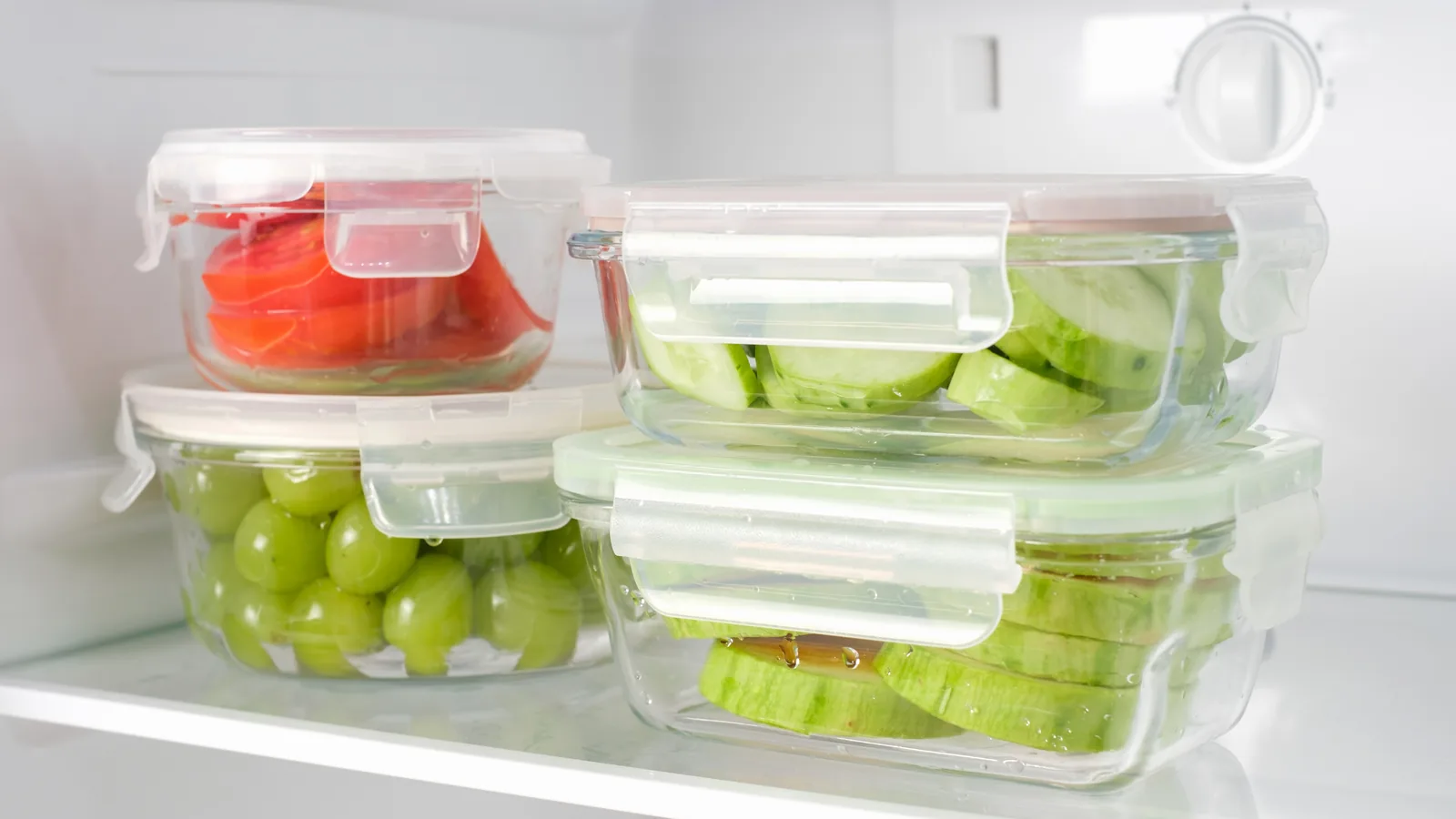
Cooked food kept in a home refrigerator at 40 F or below is good for 3 to 4 days, and frozen it keeps its quality for 3 to 4 months. Those are the numbers the USDA Food Safety and Inspection Service (FSIS) gives for leftovers, and they are the reason a Sunday cooking session cannot safely cover Friday's lunch from the refrigerator alone. The plan below is built from those figures, the FSIS cold storage chart, and the FDA Food Code, the model rule restaurants work under.
The four numbers
FSIS defines the danger zone as 40 F to 140 F, the range where bacteria multiply fastest. Perishable food left at room temperature for more than 2 hours is to be thrown out, and the window shrinks to 1 hour when the air is above 90 F. The refrigerator target is 40 F or below. Reheated leftovers must reach 165 F measured with a food thermometer, and sauces, soups and gravies are brought to a rolling boil.
Cooked meat, poultry and fish, casseroles, soups, stews, gravy and cooked egg dishes all get 3 to 4 days in the FSIS chart. Store-made or homemade egg, chicken, tuna, ham and macaroni salads get 3 to 5 days. Hard-cooked eggs in the shell keep a week. On the raw side, ground meat, raw poultry and fresh fish are 1 to 2 days, and whole cuts of beef, pork and lamb are 3 to 5 days, which matters if the plan is to cook some of Sunday's groceries later in the week.
Why restaurants get 7 days and you get 4
The FDA Food Code 2022 allows a food establishment to hold refrigerated ready-to-eat food for a maximum of 7 days at 41 F or less, with the day of preparation counted as day 1. The FDA's own guidance on that section says the limit exists to control Listeria monocytogenes, which refrigeration slows but does not stop. Restaurants earn the longer window with monitored coolers and date labels; FSIS's shorter home figure assumes a refrigerator that gets opened, a container that was warm when it went in, and no thermometer. Treat 7 days as the ceiling even a professional kitchen may not pass, not a target for a home one.
Cooling is the step most people skip
The Food Code sets a two-stage cooling rule for cooked food: from 135 F down to 70 F within 2 hours, and down to 41 F within 6 hours total. Food made from room-temperature ingredients, such as tuna salad, has 4 hours to reach 41 F. The approved methods are the ones a home cook can copy: shallow pans, dividing food into smaller or thinner portions, stirring a container set in an ice-water bath, and adding ice as an ingredient where the recipe allows.
FSIS says the same thing in plainer words. A large pot of soup takes a long time to cool and invites bacteria to multiply, so divide it into smaller containers, slice roasts and cut poultry into pieces, and either refrigerate hot food directly or chill it first in an ice bath. Hot food can go straight into the refrigerator; waiting for it to cool on the counter is the mistake, since the 2-hour clock runs the whole time.
Reheating
Both agencies land on 165 F. The Food Code adds that food reheated in a microwave is to be rotated or stirred, covered, and left to stand covered for 2 minutes afterward, because microwaves heat unevenly. FSIS makes the same point for home kitchens: cover the dish, add a little liquid if needed, vent the lid, rotate, and check the temperature in more than one spot after a rest. Frozen leftovers can be reheated without thawing; it takes longer but is safe. Anything thawed in the refrigerator must be used within 3 to 4 days, and food thawed in cold water or the microwave should be cooked right away.
A Sunday-to-Friday plan that fits the numbers
Count Sunday as day 1. Portion everything into shallow containers as soon as it comes off the heat, and get it into the refrigerator or freezer within 2 hours. Monday, Tuesday and Wednesday are days 2 through 4, inside the FSIS window for anything refrigerated. Thursday and Friday are days 5 and 6, outside it, so those portions go into the freezer on Sunday, labeled, while they are fresh. Move Thursday's meals from freezer to refrigerator on Tuesday night and Friday's on Wednesday night; refrigerator thawing is the slowest method but the food stays safe throughout, and the 3-to-4-day clock restarts when it thaws.
Egg, chicken and tuna salads can be made Sunday and eaten through Thursday under the 3-to-5-day figure. Hard-cooked eggs last the week. Rice and grains are not listed separately in the FSIS chart, so the cooked-dish figure of 3 to 4 days is the conservative read. Reheat everything to 165 F, check it with a thermometer, and when a container has been out of the refrigerator for 2 hours, including the commute and the desk, it is done.
The one piece of equipment the whole plan depends on is a food thermometer, both for the refrigerator (40 F) and the plate (165 F). FSIS's full cold storage chart and leftovers page are linked below.
Sources
- USDA Food Safety and Inspection Service: Leftovers and Food Safety
- USDA Food Safety and Inspection Service: Refrigeration and Food Safety (storage times chart)
- FDA: Food Code 2022
- FDA: Food Code 2022 full text, sections 3-403.11, 3-501.14, 3-501.15, 3-501.16, 3-501.17 (PDF)
- FDA National Retail Food Team: Food Code Section 3-501.17 Date Marking (PDF)
Loading comments…