






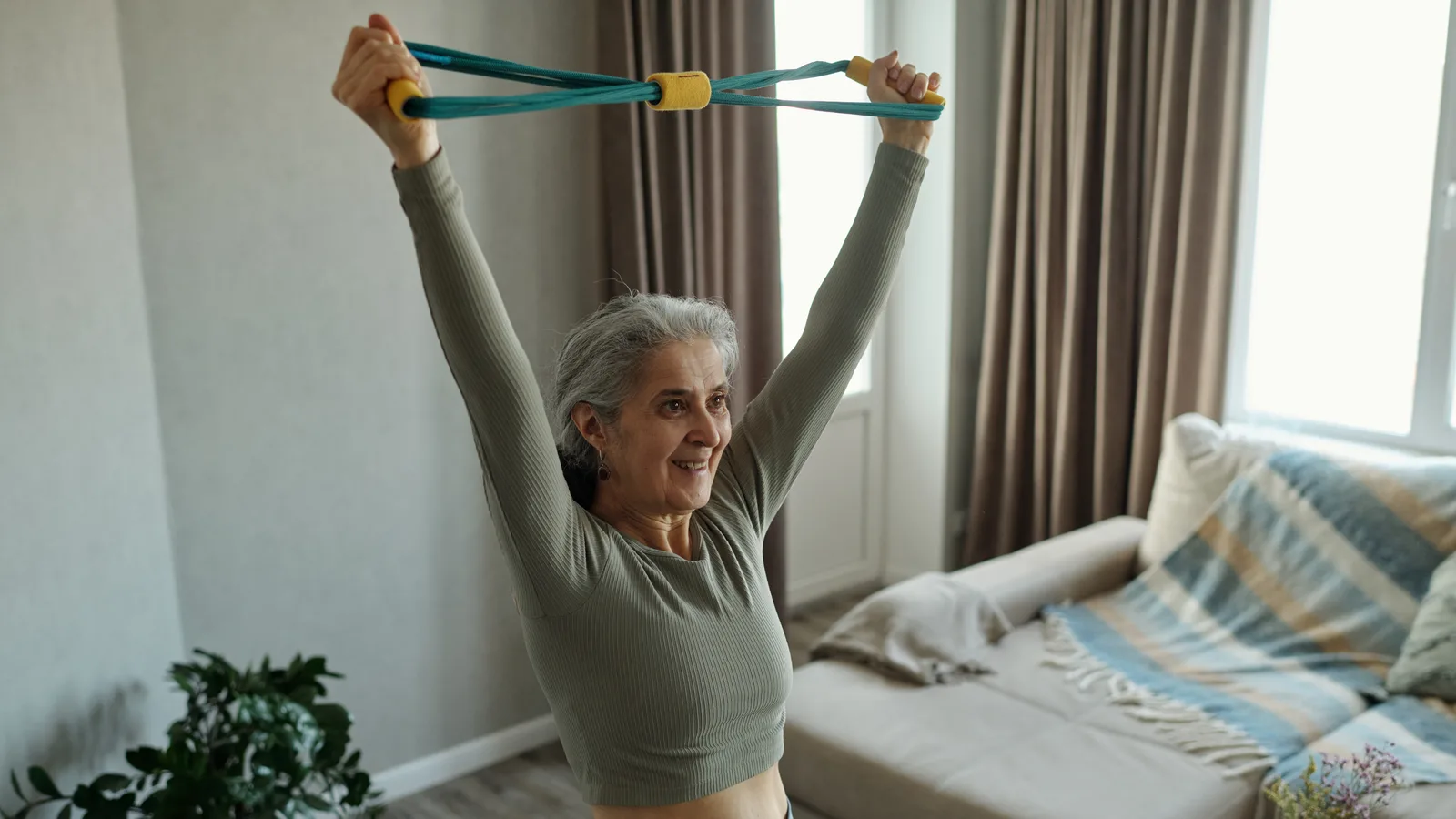
Four exercises, 30 seconds each, done once a day at home: in a randomized trial of 97 adults aged 65 and older who had trouble walking a quarter mile, that routine added about four repetitions to a 30-second chair-stand test after 12 weeks, compared with a group that did nothing new. The trial, from Penn State College of Medicine, was published in PLOS One in March 2026, and the routine is simple enough to copy with a chair, a resistance band and a single step.
What the trial tested
The program is called FAST-2. Participants averaged 74 years old, about two thirds were women, and every one of them reported difficulty walking a quarter mile while still walking without a device. Forty-four were assigned to the routine and 53 to usual care, with the program offered to the control group once the 12 weeks were over. Because the trial ran during COVID restrictions, all testing was done over video calls.
The routine itself took about four minutes. Each move was done for 30 seconds, as many repetitions as the person could manage with good form, followed by 30 seconds of rest, in the same order every day:
- Push-ups, made easier against a wall, a countertop, a step or from the knees, and made harder after a person reached 15 repetitions.
- Chair stands, standing up from an armchair and sitting back down, with hand position used to adjust the difficulty.
- Seated two-arm rows with an elastic band, using bands rated from 10 to 40 pounds.
- Stair stepping on an adjustable stepper, which rose from 4 to 6 to 8 inches as people improved.
Coaches met each participant by video at the start and at weeks 2, 4 and 8, for 10 to 20 minutes each time. A daily email reminder asked people to log their repetitions, and an audio timer and demonstration videos kept the intervals honest.
What changed in 12 weeks
Compared with the usual-care group, the exercise group finished five sit-to-stands about 2.3 seconds faster, completed about 4.2 more chair stands in 30 seconds, and held a one-legged stance about 3.6 seconds longer. All three differences were statistically significant. People completed their workouts on about 81 percent of days, roughly five or six days a week, and used an easier version of at least one move in about 41 percent of sessions.
Fewer people dropped out of the exercise group (11 percent) than the control group (28 percent). Across nearly 3,000 logged sessions, the authors counted seven orthopedic events in six people, most often shoulder discomfort; about half led to a clinic visit.
What it does not show
The trial was small and short, with no follow-up past three months, so it cannot say whether people kept the habit or whether the gains lasted. The authors note that video testing ruled out standard lab measures such as a one-repetition maximum or a six-minute walk, and that the routine was not designed to change body composition or heart health. People without internet access were excluded. No specific funding was received; the lead author reports part ownership of two fitness companies, BandUp and Play Fitness.
Set against the federal guidelines, four minutes a day is well short of the full recommendation. The Physical Activity Guidelines for Americans ask adults to do muscle-strengthening work for all major muscle groups on at least two days a week, and ask older adults to add balance training to their weekly activity. What the trial adds is evidence that a very small, very regular dose moved the functional tests that track with getting out of a chair and up a step, in people who were starting from a low base.
Running the session at home
The equipment list is a sturdy armchair, a resistance band and a low step or the bottom stair. Set a timer for 30 seconds on and 30 seconds off, go through push-ups, chair stands, rows and step-ups once, and write down the repetitions so the next day has a number to beat. The trial's own progression target was four more chair stands and two more stair steps over 12 weeks. A larger trial from the same group, comparing a five-minute daily version with a longer program three times a week, has finished enrolling and has not yet reported.
This article reports research and expert guidance. It is not medical advice. Talk to your clinician before changing medication, treatment or a medical diet.
Loading comments…