












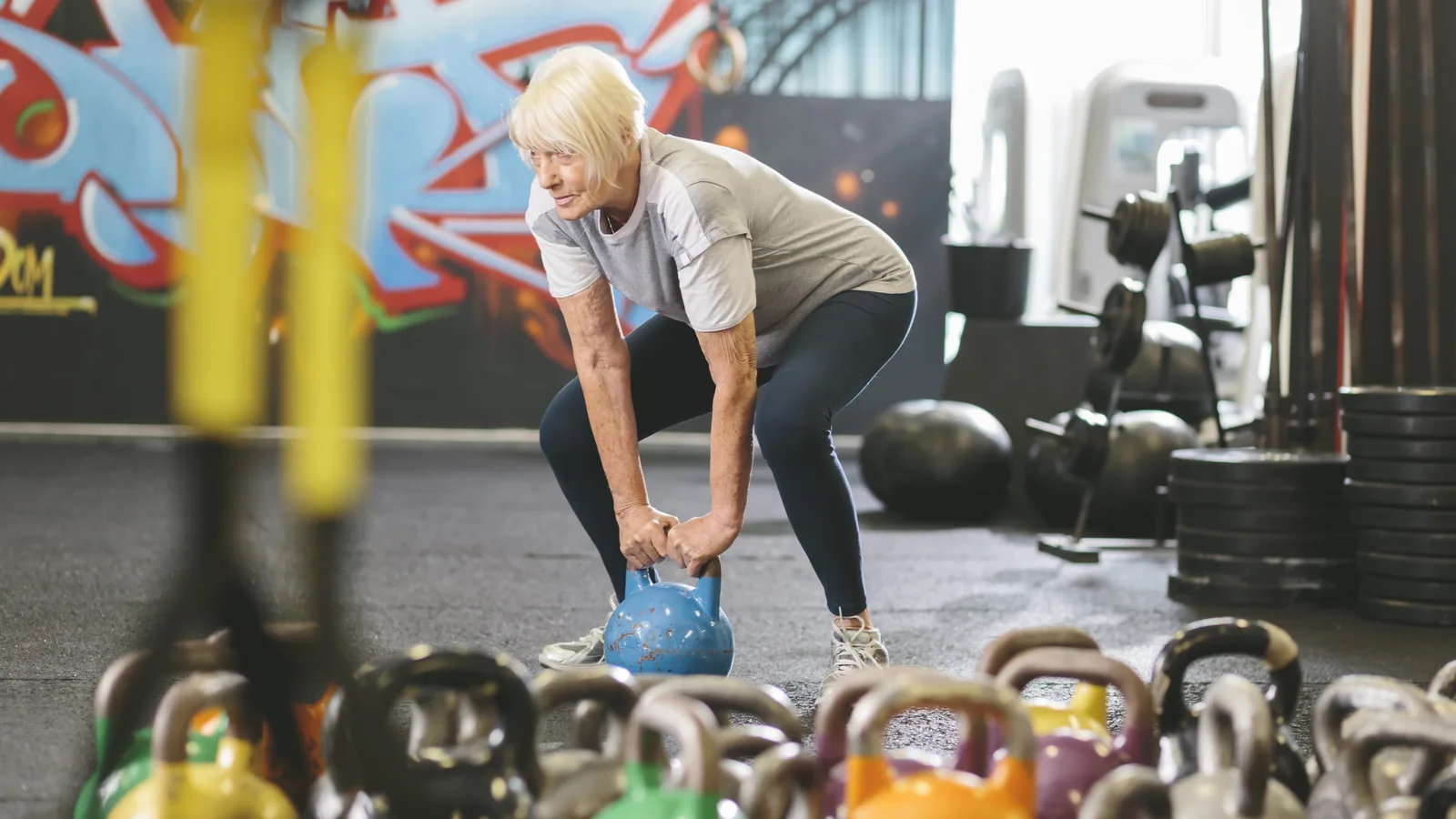
Women past menopause are usually told that heavy, slow strength training is the way to protect their bones. A randomized trial from Loughborough University in England tested that advice against a different style, lighter weights moved as fast as possible, and found the lighter, explosive version was the one that raised bone density at the hip.
The trial, called REPROOF, was published online November 15, 2026, in the journal Bone.
What the trial did
The researchers randomly assigned 109 healthy postmenopausal women ages 50 to 70 to one of three groups for eight months:
- Ballistic resistance training: supervised sessions twice a week in which the lifting phase of each move was done at maximum speed, with loads of 20 to 50 percent of each woman's one-rep max.
- Conventional resistance training: supervised sessions twice a week at 55 to 80 percent of one-rep max, taking about two seconds to lift and two seconds to lower.
- A control group that did not train.
Eighty-two women finished, with an average age of about 63 and a hip bone score (femoral neck T-score) of about -1.1, which sits in the range clinicians call low bone mass rather than osteoporosis. Attendance among those who finished was 98 percent. Bone density at the hip and spine was measured with DXA scans, and the shinbone's structure with a peripheral CT scan.
What changed
Compared with the women who did not train, the explosive group gained total hip bone density, by 0.008 grams per square centimeter on average. The gain was small in absolute terms, and the confidence interval ran from 0.001 to 0.014, so the true effect could be close to zero or nearly twice as large. In the subgroup with lower bone density at the start, explosive training raised both total hip and trochanter density.
The conventional heavy group did not change hip density compared with control. Its effect showed up in the shin instead: cortical bone density in the tibia rose, the cortical wall got slightly thinner and the shaft widened, a change in shape the authors say may affect how the bone handles bending.
What it does not show
- It is one trial with 82 finishers, and a quarter of the women who started did not complete it.
- Bone density is a stand-in. The trial was not large or long enough to count fractures, which are what matter.
- The women were healthy and mostly had low bone mass, not osteoporosis. The findings may not apply to women with osteoporosis or a history of fractures, for whom fast loading carries more risk.
- The abstract does not report who funded the study.
Where it fits
The federal Physical Activity Guidelines for Americans ask adults to do muscle-strengthening activity on at least two days a week, and the trial's twice-weekly schedule matches that. The authors' own conclusion is cautious: they write that explosive training should be developed further and tested for preventing osteoporosis, not that it should replace heavy lifting. Both programs in the trial were supervised, which is a reasonable model for anyone trying faster lifts for the first time, because speed adds load on joints and balance.
A woman with low bone density or osteoporosis who wants to add jumps or fast lifting is the person this question is most worth taking to a clinician or physical therapist, who can judge fracture risk first.
This article reports research and expert guidance. It is not medical advice. Talk to your clinician before changing medication, treatment or a medical diet.
Loading comments…