












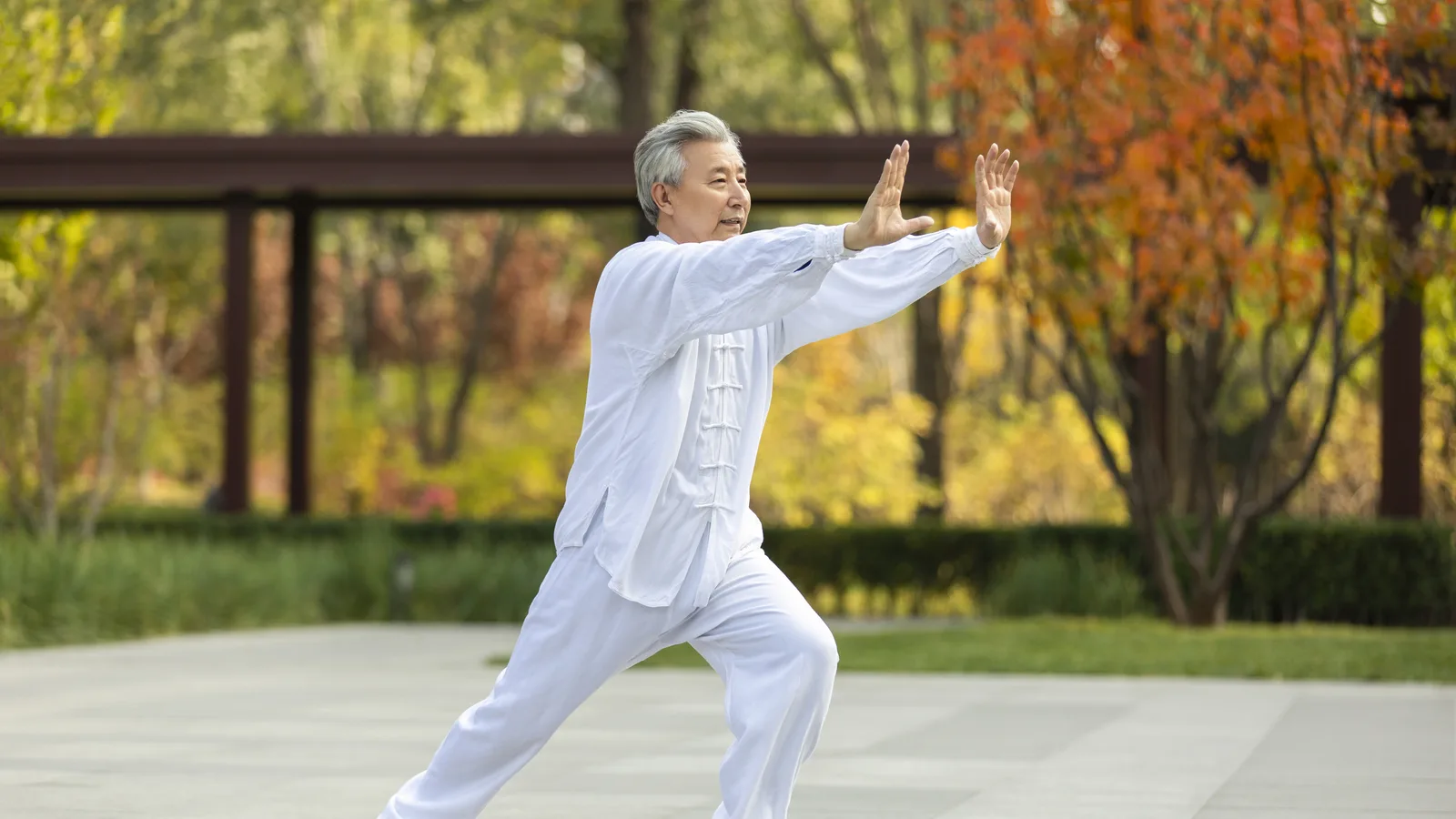
A pooled analysis of 14 randomized trials found that structured exercise programs gave older adults with chronic health conditions a modest edge on two common balance and mobility tests. The review, published on October 20, 2026 in Frontiers in Immunology, covered 857 adults aged 60 and older who lived in their own homes, and it reports a faster walking-and-turning time and a longer one-leg stand than comparison groups got.
How the review was done
The authors (Xiaofeng Cheng and colleagues) searched five databases through March 8, 2026, and kept only randomized controlled trials. They followed the PRISMA reporting standard and registered the protocol in advance in PROSPERO. Across the 14 trials the average age was about 72, and roughly two-thirds of participants were women. People with Parkinson's disease, Alzheimer's disease or dementia were excluded.
The programs fell into three buckets: tai chi-based exercise, balance training, and a catch-all group of other exercise (resistance work, home-based routines, group classes and exercise-park programs). They ran from 8 to 48 weeks, and session length and frequency varied a lot from trial to trial. The comparison groups got usual care or no structured exercise. The authors pooled results with a random-effects model, which allows for real differences between trials.
What the numbers showed
On the Timed Up and Go test, which clocks how long it takes to stand from a chair, walk a short distance, turn and sit back down, exercisers finished about 0.76 seconds faster than controls on average (95% confidence interval from 1.50 seconds faster to 0.02 seconds faster). The authors rated the certainty of that finding as low.
On the one-leg stance test, exercisers held the position about 5.45 seconds longer on average (95% confidence interval 1.45 to 9.44 seconds). Only three trials contributed to that result, and the authors rated certainty as moderate.
An exploratory subgroup look suggested bigger gains on the walking-and-turning test in people with musculoskeletal conditions (about 1.71 seconds faster) and in trials built around balance training (about 2.38 seconds faster). The difference between condition groups reached statistical significance (p = 0.038). The difference between exercise types came close but did not (p = 0.053), so the paper does not establish that one type beats the others.
What it does not show
Falls and fear of falling were not pooled in numbers, so the review cannot say whether the exercise programs reduced them. The authors also noted several limits:
- All 14 trials had some concerns about risk of bias.
- Populations, program doses and outcome measures differed widely, and most certainty ratings were low to moderate.
- Follow-up was short, and only English-language studies were included.
- There is no agreed smallest change on these tests that counts as meaningful, so a shift of under a second on the walking test may or may not matter in daily life.
- The subgroup comparisons were exploratory.
The paper reports that the authors received no financial support. The review also includes some inconsistencies in how it counts trials for the walking test (nine in the text, ten in one figure caption), which is worth knowing when reading the exact figures.
Why an everyday exerciser might care
Balance and the ability to get up and move are skills that fade quietly, and the one-leg stance and chair-walk tests are simple enough that physical therapists and fitness professionals use them in ordinary settings. This review adds to the evidence that regular, structured programs of several months, including tai chi and balance-specific training, are associated with better scores on both. It is a pooled analysis of fairly small trials, so it points to a likely direction rather than a precise prediction for any one person.
The practical next step
The full paper is open on the Frontiers site (link below), including the table listing each trial and its program. Anyone who has a chronic condition, a history of falls or dizziness can ask a clinician or physical therapist which balance tests they use and which type of program fits their situation, and what progress on those tests would look like for them.
This article reports research and expert guidance. It is not medical advice. Talk to your clinician before changing medication, treatment or a medical diet.
Loading comments…