












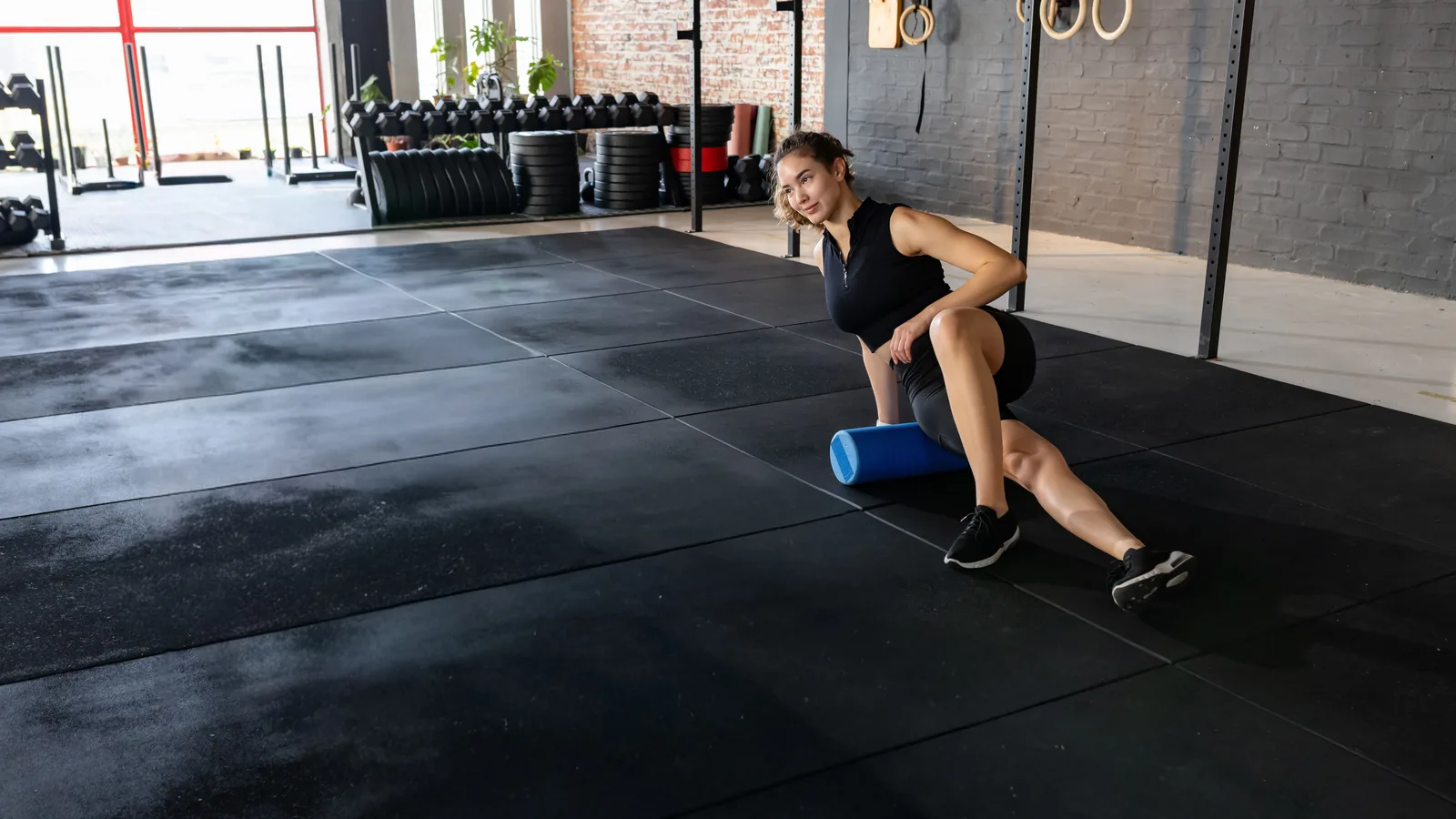
Foam rollers sit in the corner of nearly every gym, and people use them at both ends of a workout: before, as part of a warm-up, and after, to ease sore legs. The most cited review of the research suggests the two uses are not equal. Rolling before training gave a small, short-term gain in flexibility without costing performance. Rolling afterward eased soreness somewhat, and its effects on performance were small and statistically uncertain.
The review
The analysis was published in Frontiers in Physiology in April 2019 by a German team led by Thimo Wiewelhove, with funding from the German Federal Institute of Sport Science. It pooled 21 studies with 454 participants. Fourteen tested rolling before exercise and seven tested it after. Fourteen used foam rollers; seven used roller massage bars or sticks. The authors declared no conflicts of interest.
Rolling before training
Compared with no rolling, a pre-workout roll produced:
- Flexibility: about 4 percent more range of motion, a small effect.
- Sprint performance: about 0.7 percent better, also small.
- Strength: about 1.8 percent, an effect the authors rated negligible.
- Jumping: about 1.9 percent worse, also rated negligible.
The practical reading is that rolling before a session can loosen things up a little without making the session worse.
Rolling after training
After exercise, the clearest result was for how sore muscles felt. Perceived muscle pain improved by about 6 percent, a small effect, and this was the best-supported benefit of post-workout rolling. Sprint and strength numbers moved in a good direction (about 3 and 4 percent), but neither result was statistically significant, so the review cannot say they are real. Jumping did not change.
What the review cannot tell you
The authors call the overall effects of foam rolling minor and partly negligible, though sometimes relevant, and they list why the evidence is soft:
- Most of the studies were small.
- People always know whether they are rolling, so a placebo effect cannot be ruled out.
- Rolling methods varied widely, and almost no study measured how hard people pressed.
- Participants ranged from elite athletes to untrained people.
- The search ended in December 2017, so newer trials are not included.
Where that leaves the roller
The authors conclude that the evidence supports foam rolling more as a warm-up tool than as a recovery tool. Used before training, the trials found a little extra range of motion with no loss of performance. Used after, the documented effect is that muscles feel somewhat less sore. Because the review pooled foam rollers and handheld roller sticks together, it does not favor one type of roller over the other.
Loading comments…