












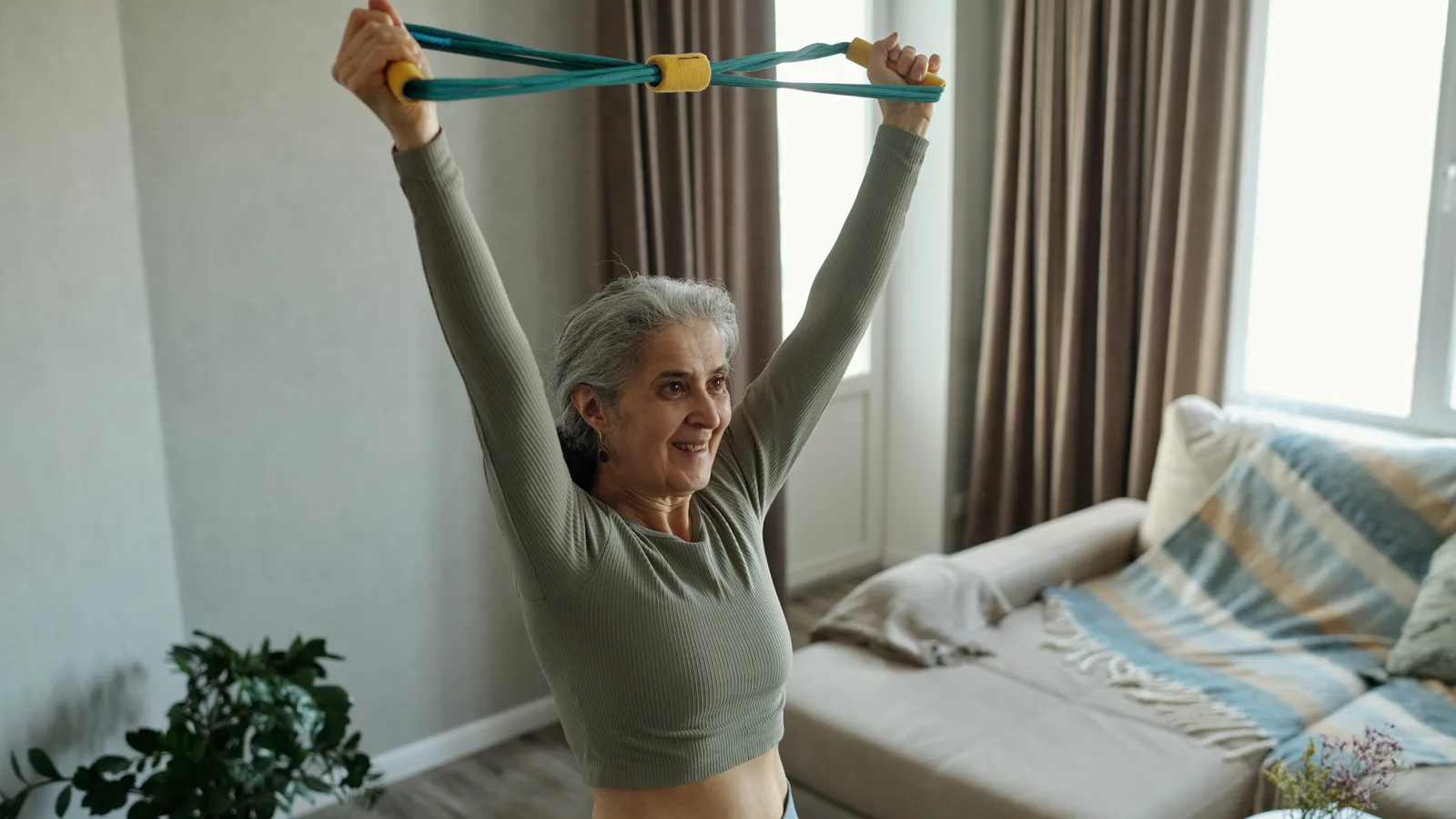
Exercising at home costs little and removes the trip to a gym, which is why it is so often suggested to women after menopause. A new meta-analysis looked at how much it delivers. Pooling 19 randomized trials, it found small, measurable gains in body mass index and quality of life, and no clear answer yet on strength, balance or walking capacity.
What the review covered
The paper was published October 29 in Frontiers in Public Health. Its three authors searched four research databases through March 2026 for randomized controlled trials of home-based exercise in postmenopausal and older women, and found 19 trials with 1,128 participants in total. They rated each trial with the Cochrane risk-of-bias tool and pooled the results outcome by outcome.
Home-based exercise in these trials meant structured programs done at home rather than in a supervised class or clinic. The review did not test one specific routine; the programs differed from trial to trial, which is one of the limits the authors name.
What improved
Two outcomes reached statistical significance. Body mass index fell by 0.57 points on average compared with control groups, a consistent result across the trials that measured it. For a woman 5 feet 4 inches tall, that is a difference of roughly 3 pounds. Health-related quality of life, measured by questionnaire, also improved, though the trials disagreed with one another on how much.
The authors graded their confidence in the BMI result as moderate and in the quality-of-life result as very low.
What stayed unsettled
Most of the physical tests leaned in a favorable direction without reaching significance, meaning the pooled data could not rule out no effect:
- Timed Up-and-Go, a test of rising from a chair, walking and returning: 0.64 seconds faster on average
- Five-times sit-to-stand: 1.92 seconds faster
- Handgrip strength: 1.43 kilograms higher (about 3 pounds)
- Six-minute walk: 35 meters farther (about 115 feet)
- Body fat percentage: 0.31 points lower
- Triglycerides: about 9 milligrams per deciliter lower
For each of those, the range of plausible results ran from a meaningful benefit to none at all. The authors attribute that to the small number of trials per outcome and to how much the programs and participants varied.
What the review does not show
It does not show that home exercise fails to build strength or mobility; it shows that the trials so far are too few and too different to say. It also cannot say whether results last: the authors note that the durability of the effects and of long-term participation in home programs remains uncertain, and they call for trials with longer follow-up that routinely report adherence and adverse events. The review was registered after the fact rather than in advance, and the authors declared no commercial or financial conflicts of interest.
How it fits the federal guidelines
The Physical Activity Guidelines for Americans do not specify where exercise happens. For adults they call for at least 150 minutes a week of moderate-intensity aerobic activity and muscle-strengthening activity on two or more days a week, and for older adults they add balance training as part of the weekly mix. A home workout counts toward all three when it includes them: brisk walking or stepping for the aerobic share, bodyweight or resistance band work for strength, and standing balance drills.
Read against that, the review's message is about expectations and design. The trials that exist support home programs as a workable way to be active, with modest average effects on weight-related measures and on how women rate their own well-being. What a given program does for strength and mobility likely depends on what is in it and whether it gets done, the two things the authors say future trials need to report.
Women with osteoporosis, joint replacements, heart conditions or a history of falls are the readers for whom a conversation with a clinician or physical therapist comes before starting a new routine at home.
This article reports research and expert guidance. It is not medical advice. Talk to your clinician before changing medication, treatment or a medical diet.
Sources
- Frontiers in Public Health: Home-based exercise in postmenopausal and older women: effects on body composition, physical function, cardiometabolic health, and quality of life, a systematic review and meta-analysis (October 29, 2026)
- U.S. Department of Health and Human Services: Physical Activity Guidelines for Americans
Loading comments…