












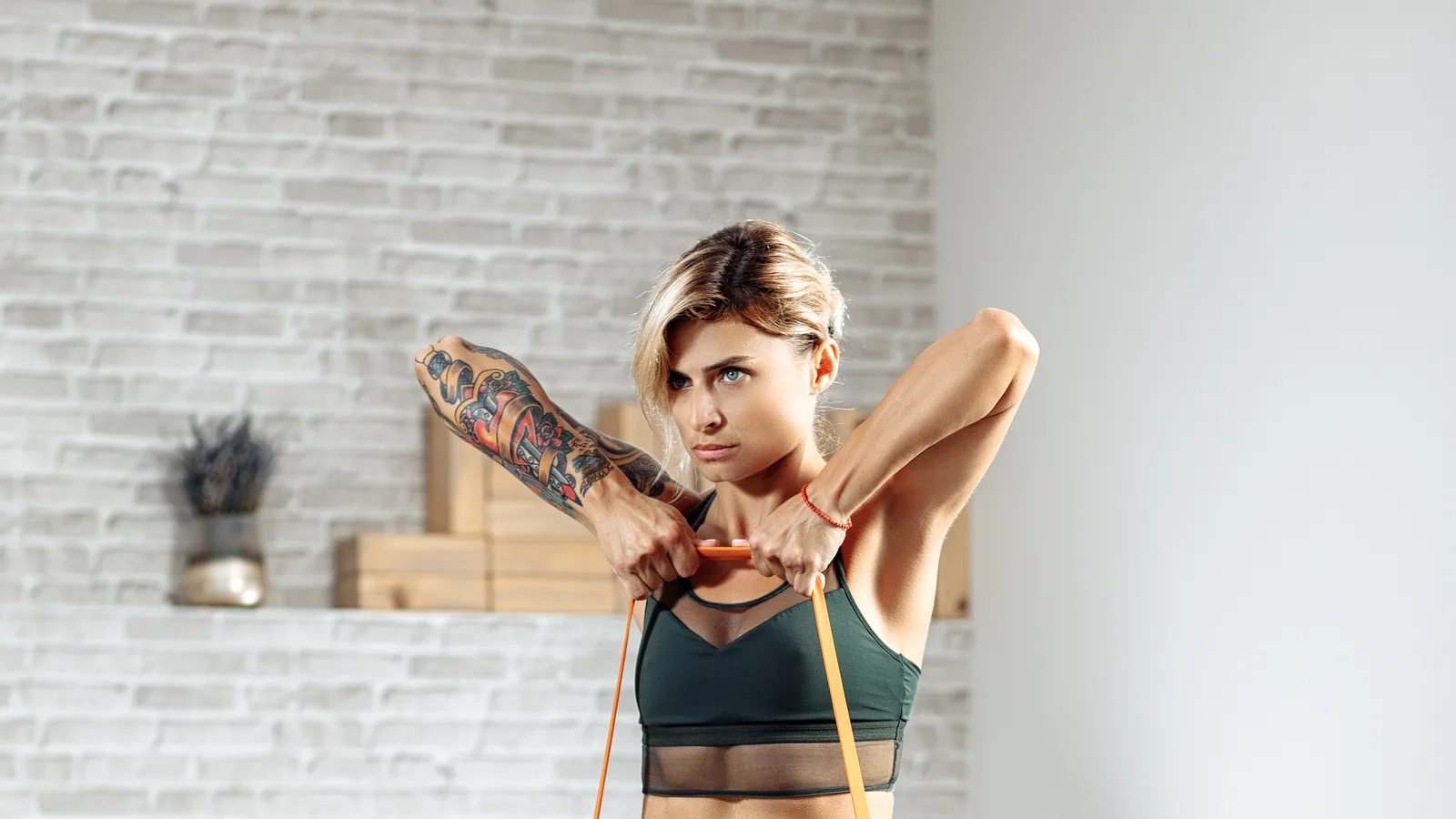
A set of resistance bands costs less than one pair of heavy dumbbells and fits in a drawer, which makes it the home gym most people can actually set up. The question that follows is whether it works as well. The best summary of the trials so far says, for strength, it largely does.
What the trials compared
A systematic review and meta-analysis in SAGE Open Medicine, by researchers at São Paulo State University and other Brazilian universities, searched four major databases for trials that put one group on elastic resistance (tubes and bands) and another on conventional equipment (weight machines and dumbbells), then measured strength. Eight studies qualified, covering different populations and programs. Pooled, there was no meaningful difference between the two in lower-body strength or upper-body strength. The authors concluded that elastic training produced strength gains similar to conventional training across those groups and protocols, and declared no conflicts of interest. A published correction later fixed the labels on the upper- and lower-body results; the conclusion did not change.
Why bands can keep up
Muscle responds to working hard against resistance, not to the type of equipment providing it. A band's resistance rises as it stretches, so it is lightest at the start of a movement and heaviest at the end, while a dumbbell weighs the same throughout. That changes how an exercise feels but, in these trials, not how much strength people gained.
How much training counts
The federal Physical Activity Guidelines for Americans ask adults to do muscle-strengthening work for all major muscle groups (legs, hips, back, abdomen, chest, shoulders and arms) on at least two days a week, and say exercises should be done until it would be hard to do another repetition without help. Bands meet that bar if the band is heavy enough. The American College of Sports Medicine's position stand on resistance training for healthy adults describes the main levers for progress: more resistance, more repetitions or sets, and less rest.
Making band work count
- Pick a band that ends each set hard. If 20 easy repetitions are possible, the band is too light for strength work. Move to the next band, double up two bands, or shorten the band by stepping farther from the anchor.
- Cover every major muscle group. A squat or split squat for the legs, a hip hinge such as a band deadlift or good morning, a row and a pull-apart for the back, a press for the chest and shoulders, and a curl and an overhead extension for the arms cover the list in the guidelines.
- Anchor it safely. Use a door anchor on the hinge side of a closed door or a solid post, check the band for nicks and dry spots before each session, and replace it when it shows wear, because a band that snaps under tension can strike the face.
- Track it. Write down the band color and repetitions each session. Progress means a heavier band or more repetitions at the same effort over weeks.
Where bands fall short
The review covered strength only. A separate 2020 meta-analysis by the same group, in Fisioterapia em Movimento, looked at body composition across four studies and found conventional equipment did better there, and eight trials is a modest evidence base. Very strong lifters may also find even the heaviest bands too light for the legs. For most people starting at home, though, the evidence points to bands as a real strength tool rather than a stopgap. Anyone with a joint injury or a heart condition who is new to strength work can ask a clinician or physical therapist which exercises suit them.
Sources
- SAGE Open Medicine: Effects of training with elastic resistance versus conventional resistance on muscular strength: A systematic review and meta-analysis (Lopes et al., 2019, with 2020 correction)
- Fisioterapia em Movimento: elastic versus conventional resistance training and body composition, systematic review and meta-analysis (2020)
- U.S. Department of Health and Human Services: Physical Activity Guidelines for Americans
- American College of Sports Medicine: Progression Models in Resistance Training for Healthy Adults (position stand)
Loading comments…