












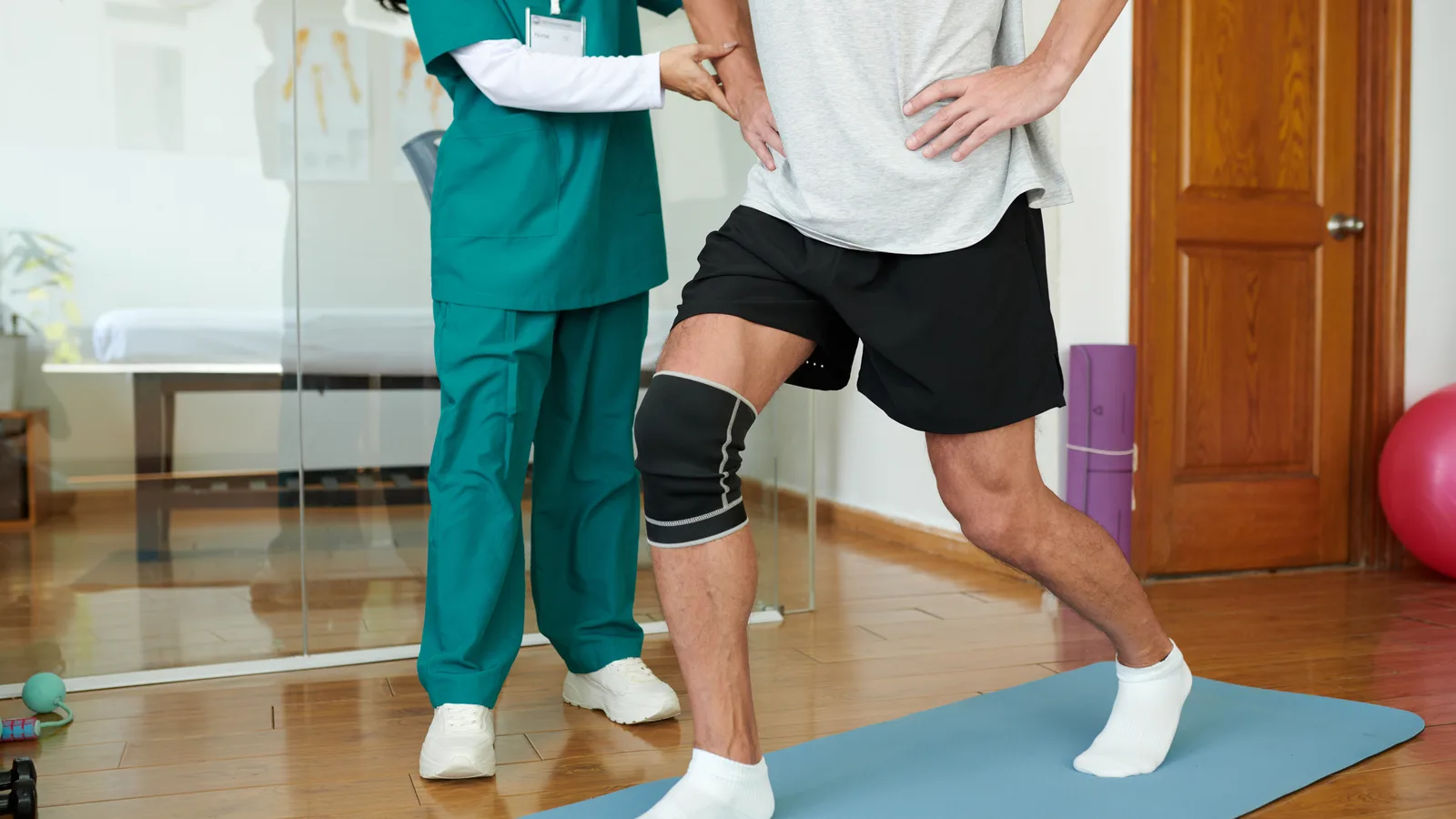
About two years after an ACL reconstruction, a lot of people in their 20s and 30s still have a knee that hurts, swells or does not trust itself on stairs. A randomized trial published in the Annals of Internal Medicine on September 29, 2026, tested whether a supervised exercise program helps those knees more than a single advice session, and the answer was yes at four months, with two important limits.
Who was in the trial
The SUPER-Knee trial, run by La Trobe University in Melbourne, enrolled 184 adults aged 18 to 40 who still had knee problems 9 to 36 months after their ACL surgery. Their average age was 30, and on average they were 2.2 years past the operation. Half were assigned to SUPER: physiotherapist-supervised exercise therapy twice a week for four months, combined with education about the knee. The other half got one session with a physiotherapist plus a set of exercises to do on their own.
Follow-up was high: 97 percent of participants were measured at four months and 95 percent at twelve. The trial was funded by the National Health and Medical Research Council of Australia.
What changed at four months
The main measure was the KOOS4, a 0 to 100 score built from the Knee injury and Osteoarthritis Outcome Score that combines pain, symptoms, sport and recreation function, and knee-related quality of life, where higher is better.
- The supervised group improved by 14.1 points, the self-directed group by 9.4.
- After adjustment, the difference between groups was 4.8 points, with a 95 percent confidence interval of 1.4 to 8.2.
- The supervised group gained more thigh muscle strength.
- More of the supervised group rated their pain as improved: 73 percent against 40 percent.
What did not change
Two findings matter as much as the headline result. First, the gap closed over time. By twelve months, the self-directed group had kept improving and the difference between the groups had narrowed, while the supervised group held its gains. The authors concluded that the between-group differences may not be sustained.
Second, the knee cartilage looked the same in both groups. The trial measured cartilage thickness and composition on MRI at four and twelve months and found no difference between groups. That matters because some coverage of the trial described the program as cutting the risk of osteoarthritis. The trial did not show that. It showed faster improvement in how the knee felt and worked, not a change in the joint structure the scans can see.
The authors name one limit themselves: participants knew which program they were in, and the main outcome is a questionnaire they filled out, so expectations could have nudged the scores.
Why the knee picture matters
A separate analysis of the same 184 people, published in the Orthopaedic Journal of Sports Medicine in July 2026, looked at their knee MRIs at the start. Cartilage loss showed up in 61 percent of the tibiofemoral joints and 51 percent of the kneecap joints, and 39 percent of participants met an MRI definition of osteoarthritis, at an average age of 30. Those MRI findings did not line up with the clinical criteria for early osteoarthritis, a mismatch between symptoms and structure that the authors flagged for further study.
What to take to your physical therapist
For someone a year or more past an ACL repair whose knee still is not right, the trial supports asking about a structured, supervised program rather than going it alone, with the understanding that its clearest benefit was getting better sooner. The program in the trial ran twice a week for four months. Questions worth bringing: whether supervised sessions are covered, how strength in the thigh will be measured and tracked, and what a home program looks like once the supervised block ends.
This article reports research and expert guidance. It is not medical advice. Talk to your clinician before changing medication, treatment or a medical diet.
Sources
- Annals of Internal Medicine: Exercise Therapy and Education for Young Adults With Persistent Knee Problems After Anterior Cruciate Ligament Reconstruction, A Randomized Clinical Trial (2026)
- Orthopaedic Journal of Sports Medicine: Knee Osteoarthritis on MRI in Symptomatic Young Adults After ACL Reconstruction From the SUPER-Knee Trial (2026)
Loading comments…