






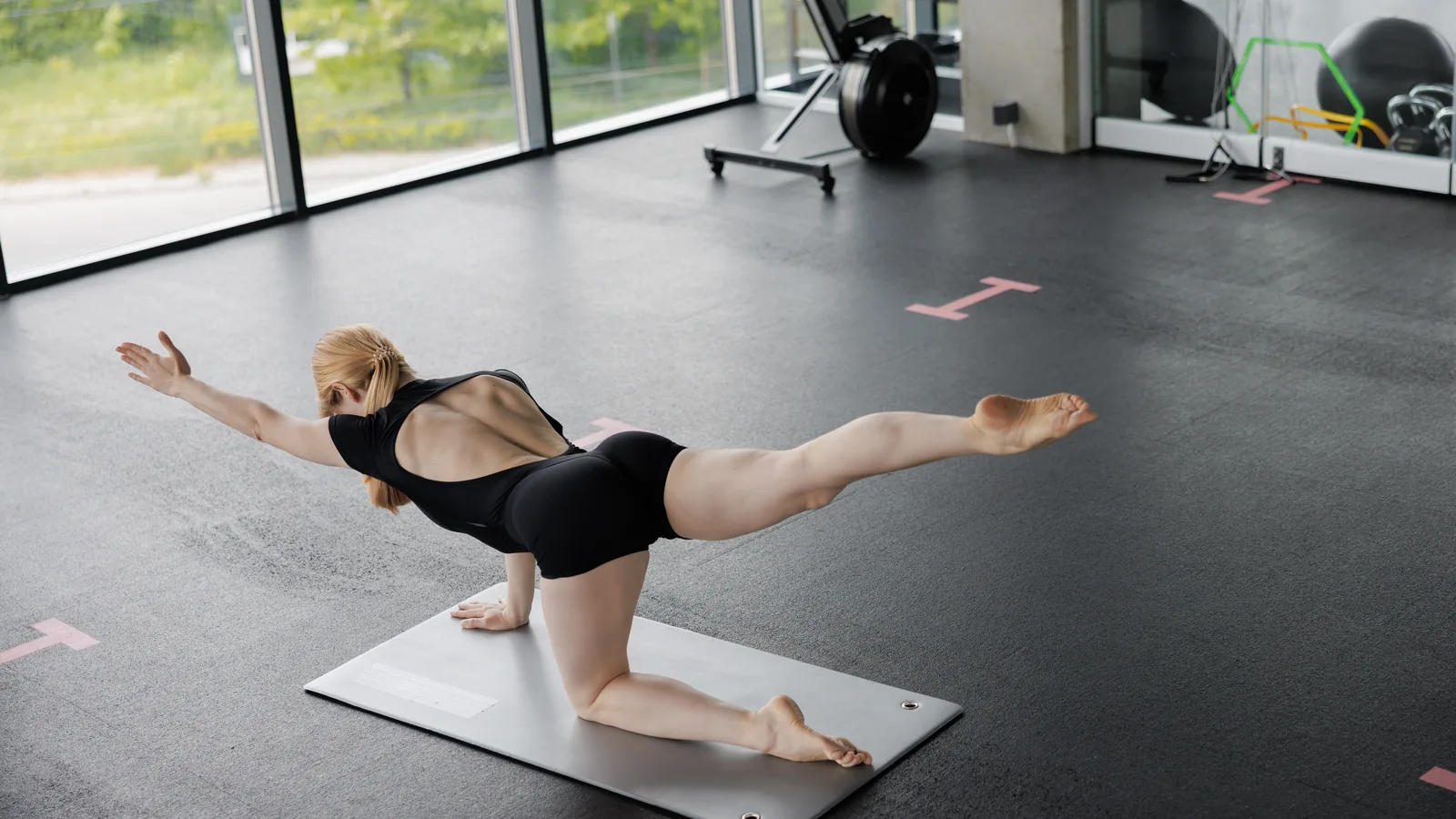
The Pilates programs tested in randomized trials are short. In the 19 trials pooled by a 2023 meta-analysis of chronic low back pain, the average program ran 6.8 weeks at about three sessions a week; in the trials pooled for older adults' balance, most ran two sessions a week of 45 to 60 minutes. The 25-minute mat session below uses exercises that recur across those trials, with reps, cues and a progression. The evidence first.
What the trials found
The International Journal of Environmental Research and Public Health published a systematic review and meta-analysis in February 2023 covering 19 randomized controlled trials with 1,108 adults with chronic low back pain. Against control conditions, Pilates was associated with lower pain (standardized mean difference 1.31) and a 4.35-point lower score on the Oswestry Disability Index, a 0 to 100 scale of how much back pain limits daily tasks. On the SF-36 quality of life questionnaire only physical function improved; a sit-and-reach flexibility result did not reach significance. Funding came from the National Natural Science Foundation of China. The authors note small trials, inconsistent Pilates methods and controls, heterogeneity and a signal of publication bias on pain.
Healthcare published a meta-analysis in December 2023 of 20 randomized trials with 930 older adults, mean ages 63 to 79, in programs of 4 to 18 weeks, most at two sessions a week. Pooled across 13 trials, Pilates was associated with better balance, a moderate effect (Cohen's d 0.65); dynamic balance, used when stepping and turning, showed the larger effect (d 0.73 across nine trials) and static balance a smaller one (d 0.56 across eight). Funding came from the Portuguese Foundation for Science and Technology. The authors flag possible publication bias, unblinded trials, small samples and a predominance of women.
Physiotherapy published a larger review in September 2021: 39 randomized trials of adults 60 and older comparing Pilates with usual or no exercise. Pooled effects were moderate for balance (standardized mean difference 0.36), strength (0.63), flexibility (0.41) and function (0.51), and large for fall risk (0.90, confidence interval 0.41 to 1.38), with certainty rated low for balance, flexibility and function and moderate for strength and fall risk. Across all three reviews the comparators were mostly inactive; the reviews do not show Pilates doing more than other exercise.
The 25-minute mat session
Equipment: a mat and a folded towel. Inhale through the nose to prepare, exhale through the mouth on the effort. Keep the low back in its natural curve unless an exercise says otherwise. Stop anything that produces sharp pain or pain that travels down a leg.
Minutes 0 to 3, set up. Lying on the back, knees bent, feet flat. Pelvic tilts, 8 slow reps, then 8 breaths drawing the lower belly toward the spine on each exhale without moving the pelvis; that brace runs through every exercise below.
Minutes 3 to 8, warm the trunk. Dead bug: arms up, knees over hips; lower the opposite arm and leg on an exhale, return on the inhale, 8 each side. Hundred (modified): head and shoulders lifted, knees at 90 degrees, arms pumping; in for 5 pumps, out for 5, 5 cycles for 50, building to 100 over weeks. Head down if the neck complains.
Minutes 8 to 14, spine and hips. Half roll back: sitting tall, hands behind thighs, roll the pelvis back until the arms straighten, hold 2 breaths, return, 6 reps. Single leg stretch: one knee in, the other leg at 45 degrees, switch on the exhale, 10 each side. Shoulder bridge: lift the hips one vertebra at a time to a line from shoulders to knees, hold 3 breaths, lower, 6 reps; progress by lifting one foot an inch at the top.
Minutes 14 to 20, side and back body. Side-lying leg series: top leg to hip height and down, 10; forward and back sweeps, 10; other side. Swimming (modified): on the front, forehead on the towel, lift the opposite arm and leg an inch, hold 2 counts, switch, 8 each side. Swan preparation: hands under the shoulders, lift the chest a few inches with the low back quiet, 6 reps.
Minutes 20 to 25, standing and finish. Standing roll down: roll the spine forward one segment at a time to a hang, rebuild from the pelvis up, 4 reps. Single-leg balance: 20 seconds each foot, hand near a wall, then with the free leg sweeping slowly forward and back, 2 rounds each side. Finish with 6 slow breaths on the back.
How to progress
The trials used programs of at least four weeks at two or three sessions a week, so the schedule matters more than any one exercise. Weeks one and two: as written. Weeks three and four: 10 more pumps per cycle in the hundred, the one-foot hold in the bridge, 30-second balances. Weeks five and six: straight legs in single leg stretch, both arms and legs together in swimming, the standing balance on a folded towel. The federal guidelines put muscle-strengthening activity at 2 or more days a week for every adult and add balance training for older adults; a mat session counts toward both and does not replace the weekly 150 to 300 minutes of aerobic activity.
For a reader with ongoing back pain the next step is a question for a clinician or physical therapist: whether a supervised program of the length these trials used fits your back, and which movements to leave out.
This article reports research and expert guidance. It is not medical advice. Talk to your clinician before changing medication, treatment or a medical diet.
Sources
- International Journal of Environmental Research and Public Health: Efficacy of Pilates on Pain, Functional Disorders and Quality of Life in Patients with Chronic Low Back Pain: A Systematic Review and Meta-Analysis
- Healthcare: The Effectiveness of Pilates Training Interventions on Older Adults' Balance: A Systematic Review and Meta-Analysis of Randomized Controlled Trials
- Physiotherapy: Pilates improves physical performance and decreases risk of falls in older adults: a systematic review and meta-analysis
- HHS Office of Disease Prevention and Health Promotion: Physical Activity Guidelines for Americans, Top 10 Things to Know
- HHS Move Your Way: Physical Activity for Older Adults
Loading comments…